Get Free Quote
-
Tel/Whatsapp +86-13925899945
-
Email: info@showcasecabinet.com








MDF vs Plywood for Store Fixtures: Which Should You Choose?
MDF vs plywood for display fixtures: strength, moisture, finishes and cost compared by a fixture factory that builds with both — plus when each one wins.
Table of Contents
- What are MDF and plywood?
- Which one is stronger for display fixtures?
- How do they handle moisture and humidity?
- Which one paints and finishes better?
- Which is cheaper for shop fitting?
- Which should you choose for display cases?
- FAQs
Key takeaways: MDF and plywood are the two workhorse materials in store fixtures, and they are not interchangeable. MDF gives a smooth, paint-ready surface and clean routed details at lower cost; plywood gives higher strength-to-weight, better screw holding and better moisture behaviour. Most retail display programs we build use both — plywood for structure, MDF for finished panels — and the fastest way to get the decision right is to match material to panel position, not to pick one for the whole store.
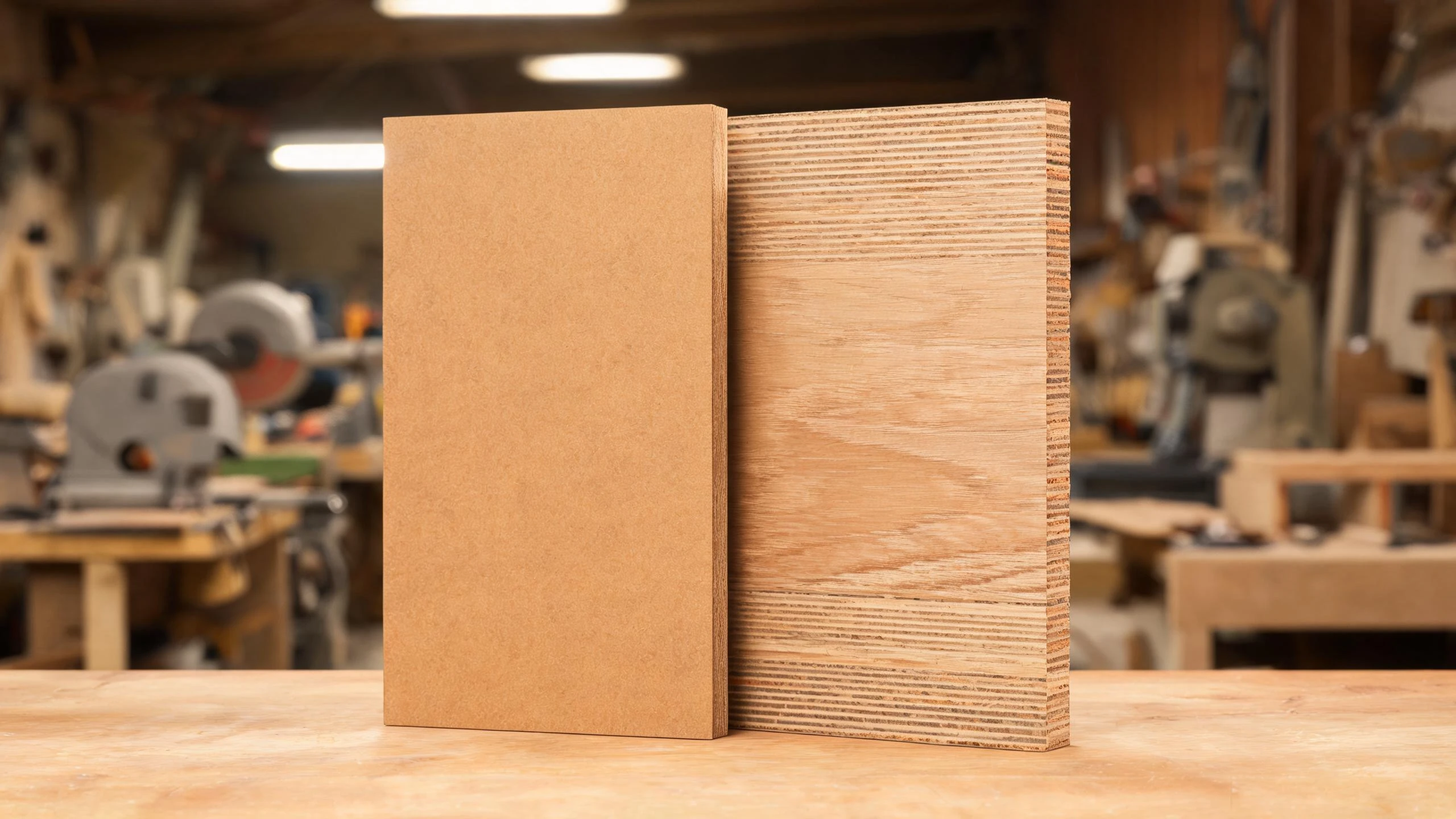
What are MDF and plywood?
Both start as wood, but they take opposite routes.
MDF — medium-density fiberboard — is made by breaking hardwood and softwood down to wood fibres, combining them with resin, and pressing them into a dense, uniform sheet. There is no grain direction at all: the panel is the same density all the way through, from face to core.
Plywood is made by peeling logs into thin veneers and gluing them in cross-banded layers — each ply rotated 90 degrees from the last. That cross-grain stack is what gives plywood its strength: a failure in one layer has to fight the fibres of the next.
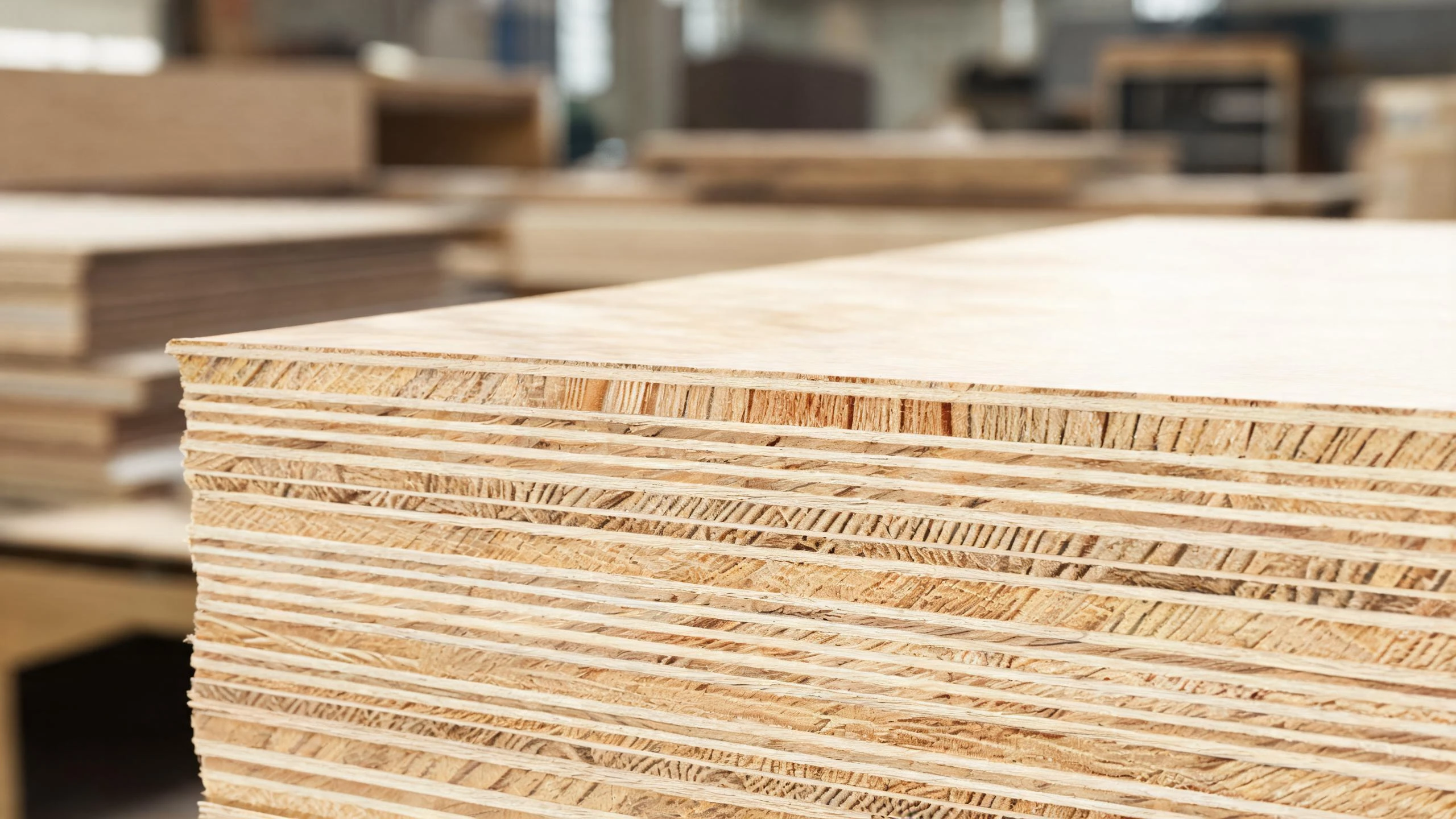
The difference shows up the first time you cut both. MDF cuts like a homogeneous block; plywood reveals its stack of layers. Everything that follows — strength, finishing, moisture, cost — comes from this one structural difference.
Which one is stronger for display fixtures?
Plywood, and it is not close. A same-thickness plywood panel holds more load, bends less over long spans, and — more important for fixtures — holds screws far better. MDF’s uniform fibre core grips a screw like compressed cardboard: it works, but pull-out resistance is roughly half of plywood’s, and repeated re-assembly degrades the hole fast — the fastener-and-strength data the USDA Forest Products Laboratory’s Wood Handbook documents across panel products.
This matters for store fixtures specifically in three places:
- Shelves spanning glass or drawer units — plywood resists sagging; wide MDF shelves need thicker stock or a support rail.
- Screwed hardware — drawer slides, lock cases, brackets and cam fittings all bite harder in plywood.
- Knock-down (KD) shipping — flat-packed fixtures get assembled and re-assembled; plywood joints survive this, MDF joints loosen.
MDF’s edge, though, is routed detail. Fluted bases, reeded panels, arches and curved front rails — the decorative work that defines current fixture design — machine cleanly in MDF and chip or tear in plywood. If your fixture program calls for routed texture, MDF is doing that job.
How do they handle moisture and humidity?
Neither belongs outdoors, but indoors they behave differently.
MDF swells noticeably when its edge takes on water — an unsealed edge left in a damp environment can expand and never fully recover. Standard MDF is the risk; MR (moisture-resistant) MDF, green-tinted and resin-loaded, buys real margin for humid climates and is what we specify for tropical-market stores.
Plywood also moves with moisture, but it moves less and recovers better, because the cross-banded structure resists uniform swelling. A sealed plywood edge shrugs off humidity that would ruin a raw MDF edge.
Practical rule for retail: any surface that gets wiped daily — counter decks, display tops, checkout counters — should be MDF with a sealed top coat, plywood with an edge-banded laminate, or solid surface. Raw edges near floor level in humid regions should be sealed regardless of material.
Which one paints and finishes better?
MDF, decisively. Its surface has no grain, no voids, no raised patches — primer goes on flat, and a sprayed MDF panel finishes like lacquered furniture. High-gloss boutique white, satin colour-matched lacquer, and metallic finishes all sit cleaner on MDF.
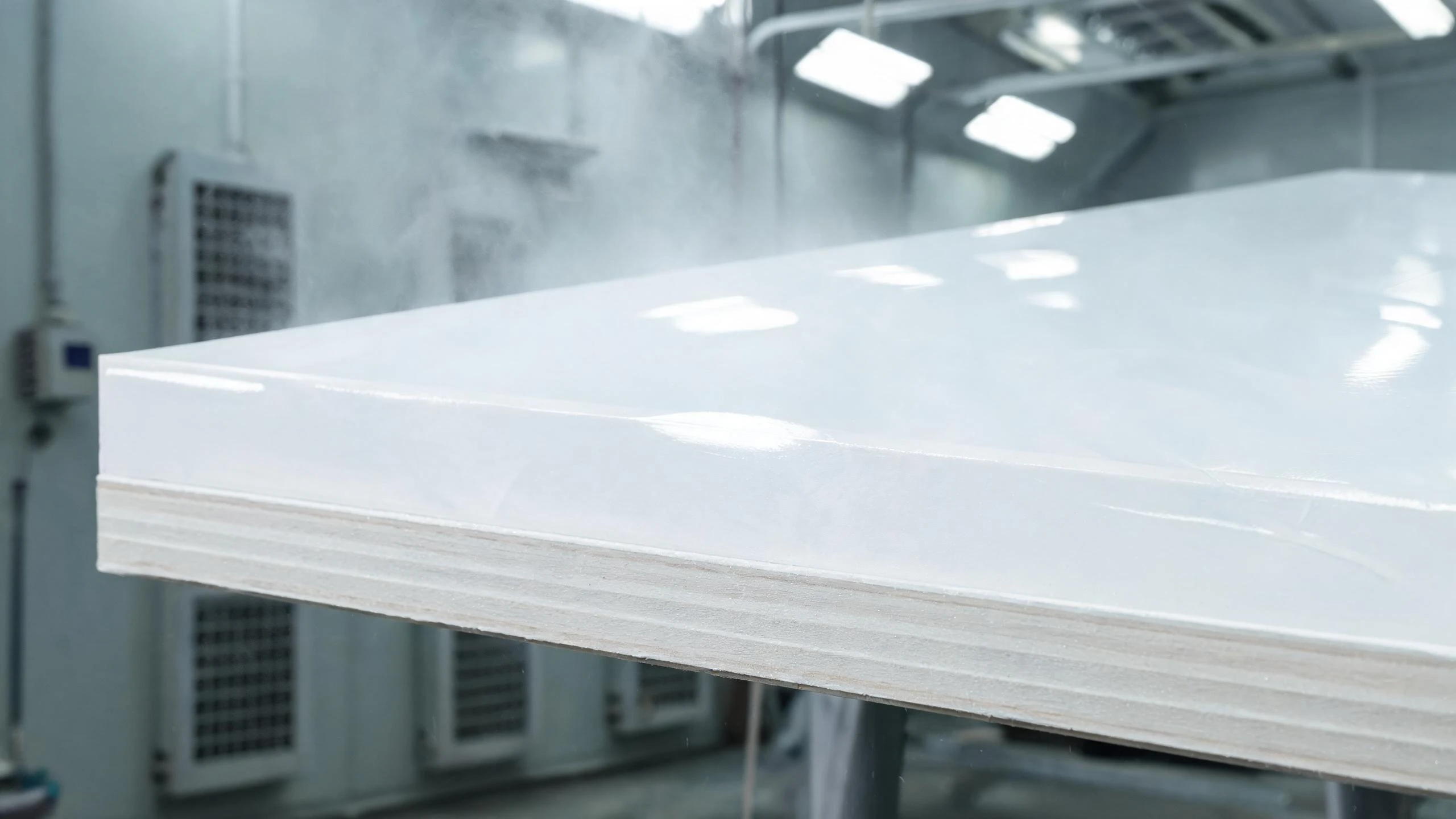
Plywood’s face can be painted, but grain telegraphs through over time and the edges need edge-banding or filling. Where plywood shines is as finished veneer — exposed birch or walnut ply on shelving has become a retail look in its own right, warm and honest, no paint needed.
So the finish logic splits cleanly:
- Painted colour programs (white, green, black boutique palettes) → MDF.
- Exposed wood-look programs (birch, walnut, oak retail) → veneered plywood.
- Routed decorative detail (flutes, reeds, curves) → MDF.
Which is cheaper for shop fitting?
Sheet for sheet, MDF runs cheaper — typically 15 to 30 percent below furniture-grade plywood in most markets. But the sheet price is only half the bill. Factor in:
- Machining cost: MDF is faster to route and finish — complex decorative work is cheaper in MDF.
- Hardware and re-work: plywood’s screw-holding means fewer stripped holes and less repair on re-assembly.
- Weight: MDF is roughly 30 percent denser — heavier shipping. For export fixture programs, plywood’s lighter weight claws back part of its price premium in freight.
- Thickness choices: plywood needs no upsize on long spans; MDF often steps up one thickness to match stiffness, eroding its cost edge.
Net result on a full-store fixture program: the two often land within 10 percent of each other, which is why the material decision should ride on performance, not on sheet price alone.
Which should you choose for display cases?
After building both into thousands of store programs, here is the decision we actually apply:
- Structural carcass, base frames and long shelves → plywood. It carries load, holds hardware and survives KD shipping.
- Finished front panels, routed bases and painted colour work → MDF. It finishes better and machines detail plywood cannot.
- Humid-climate stores → MR-MDF or marine-grade plywood, all edges sealed.
- Exposed wood-look shelving → veneered plywood, no paint.
- Particle board → only for low-load, short-life particle board shelving applications like temporary gondola extensions or back-of-house storage; it is the cheapest sheet good but the weakest under repeated handling.
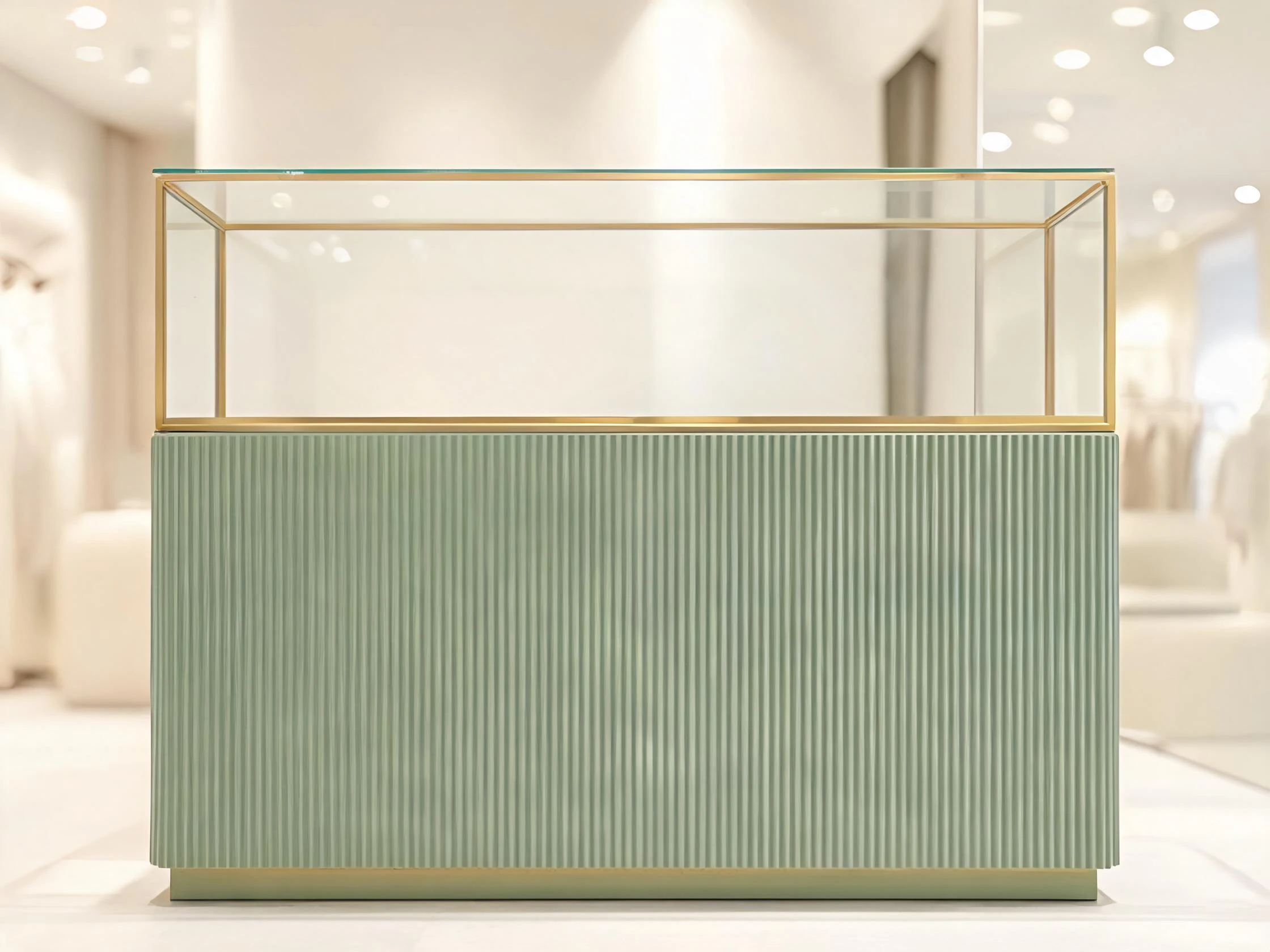
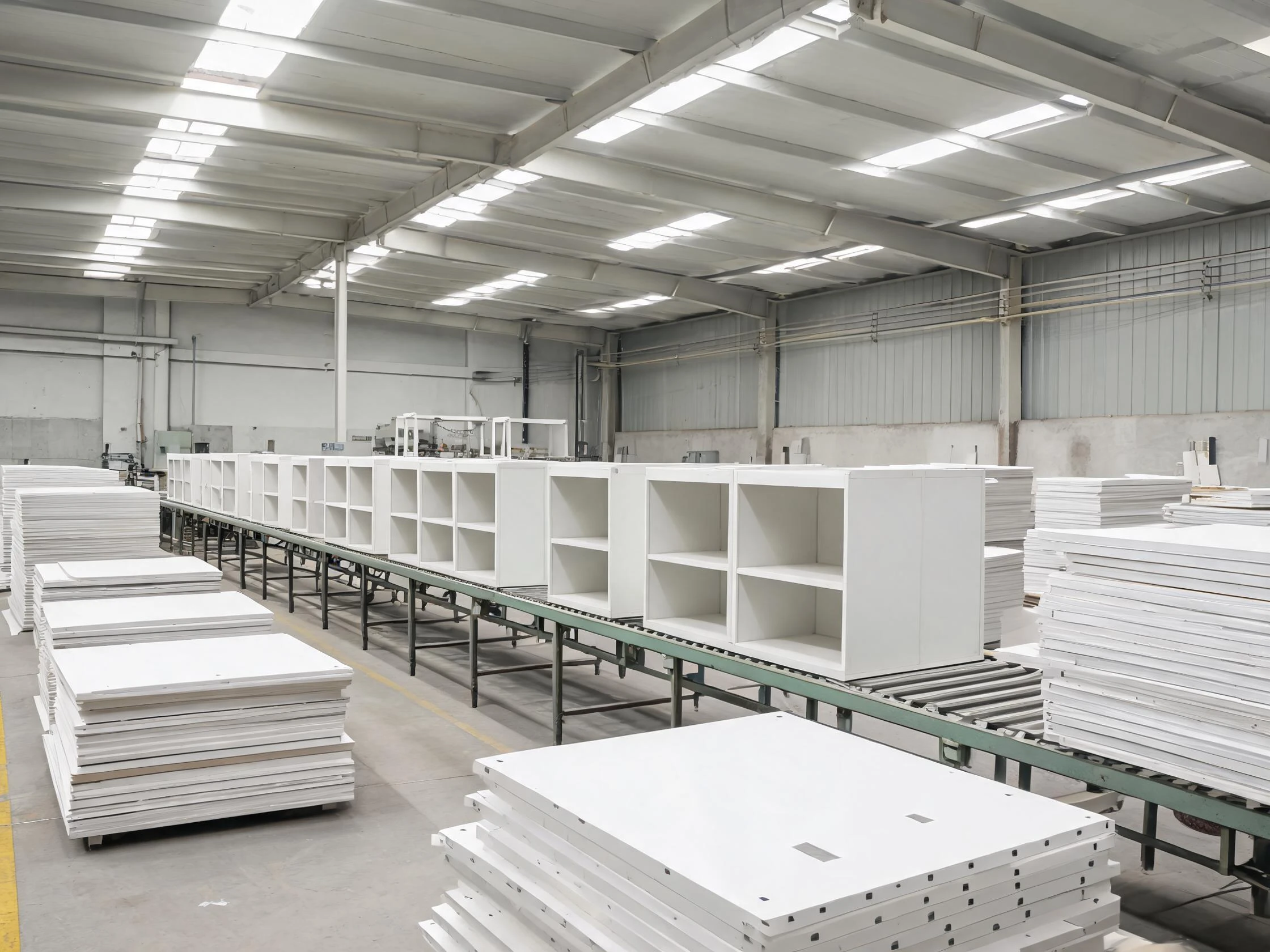
Look closely at a well-built display case and you will usually find both materials in one unit: a plywood skeleton doing the structural work, and MDF panels doing the visible finishing. Our bronze-framed MDF display counters follow exactly this build — and the modular showcase program pairs MDF finished panels with a steel-and-plywood frame so kiosks survive repeated assembly. If you are weighing how these materials slot into the broader fixture families, the types of display cases guide maps them by format.
FAQs
Is MDF weaker than plywood?
Yes, in bending strength and screw-holding. For panels that carry load or get re-assembled, plywood is the safer choice. For static finished panels, MDF’s strength is more than adequate.
Can MDF be used for shelves?
Short spans, yes. Over long unsupported spans MDF sags where plywood holds — spec a support rail or step up one thickness.
Does MDF off-gas more than plywood?
Both use formaldehyde-based resins; modern E1/E0-grade sheet from either family meets indoor-air standards. In the U.S., the EPA rule under TSCA Title VI sets the federal emission limits for MDF and particleboard directly. Sealed finishes cut emission further.
Which lasts longer in a retail store?
The one matched to its job. Plywood structures outlast MDF structures under handling; well-finished MDF panels hold their appearance as long as the fixture around them.
Choosing materials case by case is exactly what a fixture factory does daily. Tell us your store layout, climate and product weight, and we will spec the sheet goods, finishes and hardware for the program — from a single counter to a full store fit-out.