Get Free Quote
-
Tel/Whatsapp +86-13925899945
-
Email: info@showcasecabinet.com








7 Types of Display Cases for Retail Stores
The 7 display case types retailers actually buy: counters, wall cases, towers, pedestals, domes, kiosks and tables, with dimensions, glass specs and price bands.
Table of Contents
- Key Takeaways
- What are the main types of display cases?
- How do you choose a display case for your products?
- What glass should a display case use?
- How much do the different types cost?
- FAQ
Key Takeaways
- Six formats cover almost every retail floor: counter, wall case, tower, pedestal, kiosk and table. The seventh, rotating cases, serves one job: impulse.
- Match the format to product value. Open tables carry bulk stock; lockable low-iron glass carries anything a thief can pocket.
- Standard working heights: counters at 90–110 cm, wall cases mounted with shelves at 140–170 cm, towers running 150–200 cm tall.
- Choose glass by product: low-iron for colour-critical goods, laminated where security matters.
- Factory-direct pricing runs single counters from the low hundreds of dollars; full-store programs reach five figures. Sample in 7–10 days.
“Display case” is a catch-all that hides how different the formats are. A jewellery counter and a supermarket dump bin share a category name and almost nothing else. If you’re specifying fixtures for a store, you need to know the types of display cases available before you compare quotes, because each type answers a different question about your stock. Here are the seven formats retailers actually buy, with the dimensions and glass specs that matter for each.
What are the main types of display cases?
Seven formats, split by where they sit on the floor and how much protection they give.
1. Glass display counters
The workhorse. A waist-high cabinet with a glass hood, standing in aisles or along walls, with lockable storage under the deck. This format carries most of a store’s selling stock: trays under glass, staff serving from behind. Working height 90–110 cm, depth 60–70 cm, hood lighting at 4000K against a 3000K room.
Our checkout counters collection shows the format in both service and display versions. For how the service half works, see 12 retail checkout counter ideas.

2. Wall display cases
Mounted or built in along the back wall, these hold shelves at 140–170 cm — standing eye level — under internal lighting. Wall cases free your floor for selling, and they suit narrow shops where an island would choke the aisle. The trade-off: staff can’t serve from behind them, so they work best for stock customers ask for, not stock they browse.

3. Tower display cases
Tall vertical units, 150–200 cm, standing in corners or at store entrances. Towers carry less stock than any other format but they pull customers deeper into the store, because they’re visible from across the floor. Retailers use them for hero stock and seasonal lines. A jewelry window display tower shows the format built for a shopfront.

4. Pedestal and dome displays
A single piece on a stand, sometimes under a glass dome. Pedestals sell through isolation: one product, nothing beside it, customers walk around it. Museum shops and high-ticket retailers use them for exactly the pieces that need ceremony. For the format in miniature, this dome jewelry pedestal shows the classic build.

5. Island and kiosk formats
Freestanding floor units with display on all sides — the format of mall concessions and centre-store programs. An island gives you selling surface where walls don’t exist, and a kiosk adds a service counter to one edge. Stores under 20 m² and mall operators buy this format almost exclusively. The modular jewelry island shows the build, and our jade display case project shows a full concession floor planned around it.
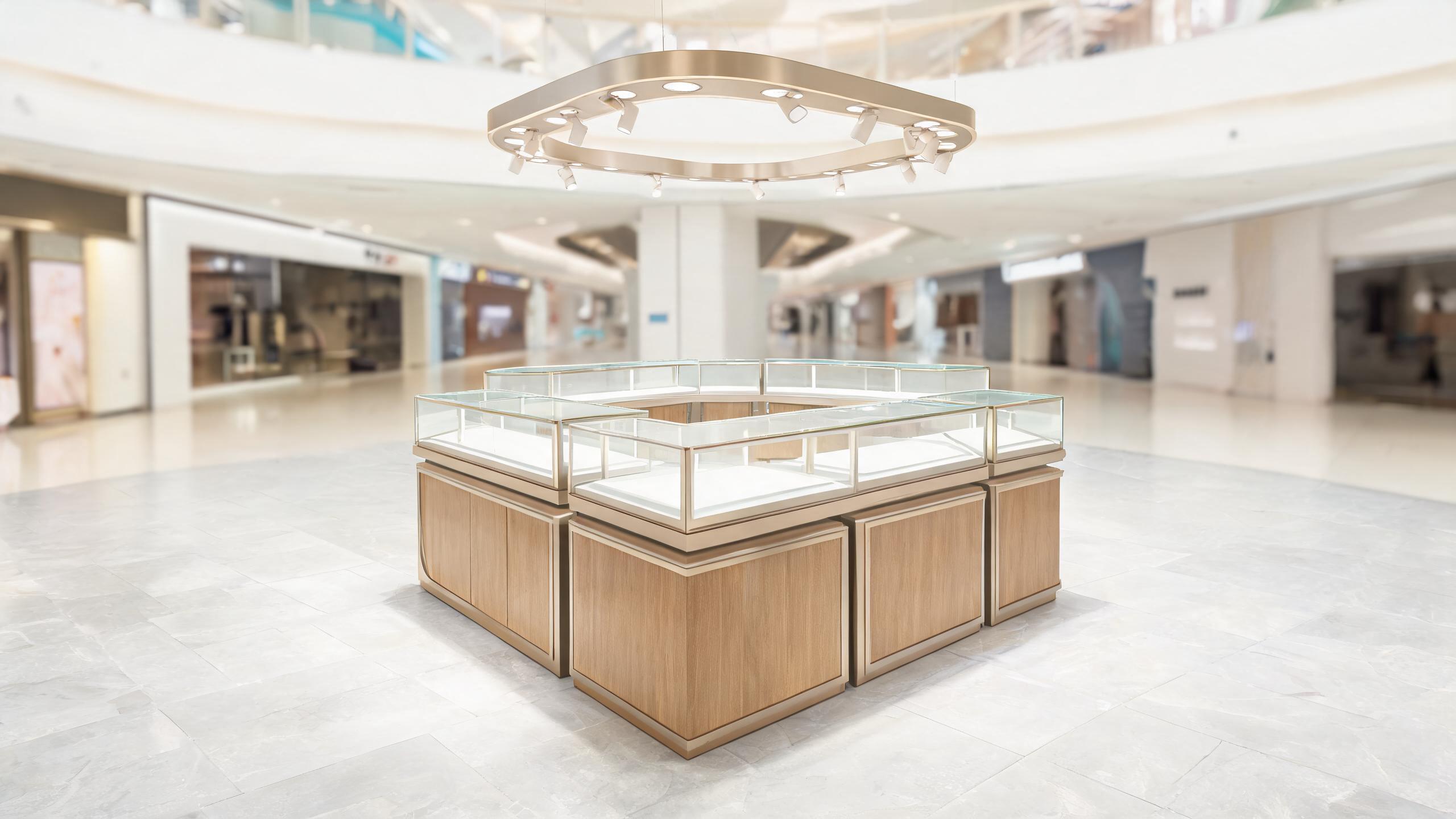
6. Open display tables
No glass, no locks — just a surfaced table at 75–90 cm with trays or risers on top. Customers handle the stock themselves. Fashion accessories, low-value giftware and try-on-heavy goods belong here, because the barrier between browsing and buying disappears. Pair them with staff sightlines, not with anything worth stealing.
7. Rotating displays
A motorised base that turns the stock slowly, inside a glass column or on an open carousel. Rotating cases exist for one job: catching the eye from a distance, in mall walkways and store windows, with impulse-priced goods. They carry little stock and cost more per square metre than any other format here, so use them sparingly — one at the entrance, not five.
How do you choose a display case for your products?
Two questions decide it: how much is the stock worth, and how should customers touch it?
High value, hands-off — the counter, wall case and pedestal formats, all lockable. Mid value, guided browsing — towers and islands, glassed but open-sided. Low value, self-service — tables and rotating units, no glass at all. Within each band, your floor size picks the format: narrow shops go vertical with wall and tower cases, wide shops can afford islands.
If you sell jewelry specifically, the format mix gets stricter, because security and lighting follow the product. Our 15 jewelry display ideas breaks that mix down by product family.
What glass should a display case use?
Three specs matter. Low-iron glass stays colourless where standard glass reads green at the edges — worth it for diamonds, gemstones and anything white. Laminated glass holds together when struck, so smash-and-grab attempts fail slowly enough for alarms to matter; use it for anything insurable. And tempered glass, the default elsewhere, shatters into blunt chunks for safety but protects nothing.
Most programs mix all three: laminated hoods on counters, low-iron on pedestals and towers where the product faces the glass, tempered on wall cases holding stock the customer asks for.
How much do the different types cost?
At factory-direct pricing, open tables start lowest, single counters run the low hundreds of dollars, towers and wall cases cost roughly a counter each, and kiosk programs — island, counter, signage, lighting — reach the low thousands. Full-store fixture programs land between five and six figures depending on format mix and finish level.
Materials move the price more than format does: metal frames over wood, low-iron over standard glass, and lighting spec per unit all add faster than adding another unit. When you compare quotes, compare these line items, not the total. Expect a sample in 7–10 days and production in 30–45 days direct from a factory.
FAQ
What is the difference between a display case and a display cabinet?
Nothing structural — the words swap by region and industry. “Display case” dominates in North American retail, “display cabinet” in British usage. Check which term your customers search in your market before naming product pages.
Which type of display case is most secure?
A counter with laminated glass, recessed locks and the deck inside the locked volume. Pedestals and towers with domes protect single pieces well; wall cases are only as secure as their mounting and their locks.
Can display cases be moved once installed?
Freestanding formats — counters, towers, islands, pedestals — relocate with a pallet jack and re-levelling. Wall-mounted cases need remounting. Plan the floor first, then bolt.
How many display cases does a small store need?
A 20 m² store typically runs one island plus one wall run — four to six units total. Under that, the store reads as a stall; over it, you’re paying for fixtures with no stock to fill them.
Specifying fixtures for a store? Send us your floor plan and product list. We’ll return a format mix with dimensions, glass specs and an itemized factory quote. Samples in 7–10 days, production in 30–45.