Get Free Quote
-
Tel/Whatsapp +86-13925899945
-
Email: info@showcasecabinet.com








15 Jewelry Display Ideas for Retail Stores
15 jewelry display ideas that sell: tiered trays, lighted cases, dome pedestals, lockable counters and kiosk formats, with heights and color temps.
Table of Contents
- Key Takeaways
- How should you display gold chains and bangles?
- What lighting sells jewelry best?
- When should displays go on the wall?
- How do you make a hero piece stand out?
- How do you protect high-value stock?
- What display works in a small store?
- FAQ
Key Takeaways
- Counter height 90–110 cm keeps trays at standing eye level; leave aisles of 90–120 cm so staff can pass customers carrying trays.
- Light cases brighter and cooler than the room: 4000K inside the case against 3000K ambient, CRI 90 or higher.
- White and light-grey liners suit gold and colored stones. Deep velvet only for diamonds.
- Lockable cases with laminated glass for high-value lines, and a floor plan where staff see every unit.
- Custom builds run sample in 7–10 days, full production in 30–45 days from a factory.
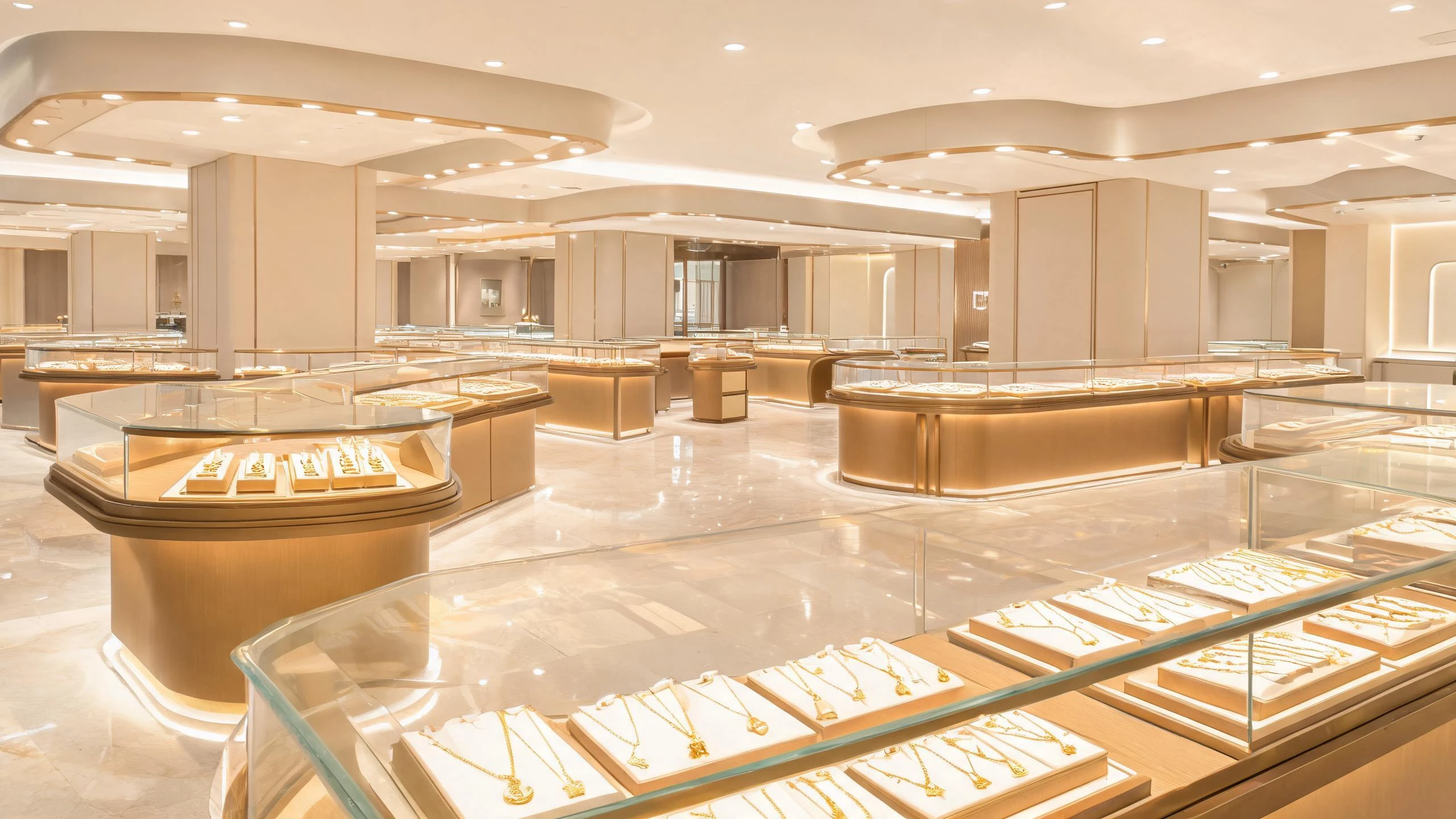
Good jewelry display ideas do one job: they get pieces lifted out of the case. The layout decides whether a customer walks your whole store or turns back at the first counter. If you’re working out how to display jewelry in a new space, the fifteen layouts below are a good place to start. We build display furniture for jewelry stores, and every idea here comes from a store we’ve actually shipped, tray counts and glass specs included. Steal whatever fits your floor plan.
How should you display gold chains and bangles?
Flat in tiered trays, with a hanging bar for whatever tangles.
1. Tiered tray wells
Build the counter interior as stepped wells, each holding a tray insert. Two or three tiers per well keeps every chain visible without stacking. Stores running volume gold usually fill twelve to sixteen trays per counter run.
2. A vertical chain bar
Chains displayed hanging never knot, and customers can lift one off its hook without touching the rest. Put the bar at the back of the case so trays stay in front.
3. Bangle ramps
A short ramp displays six to eight bangles in the footprint of two lying flat. Angle it toward the customer side of the glass.
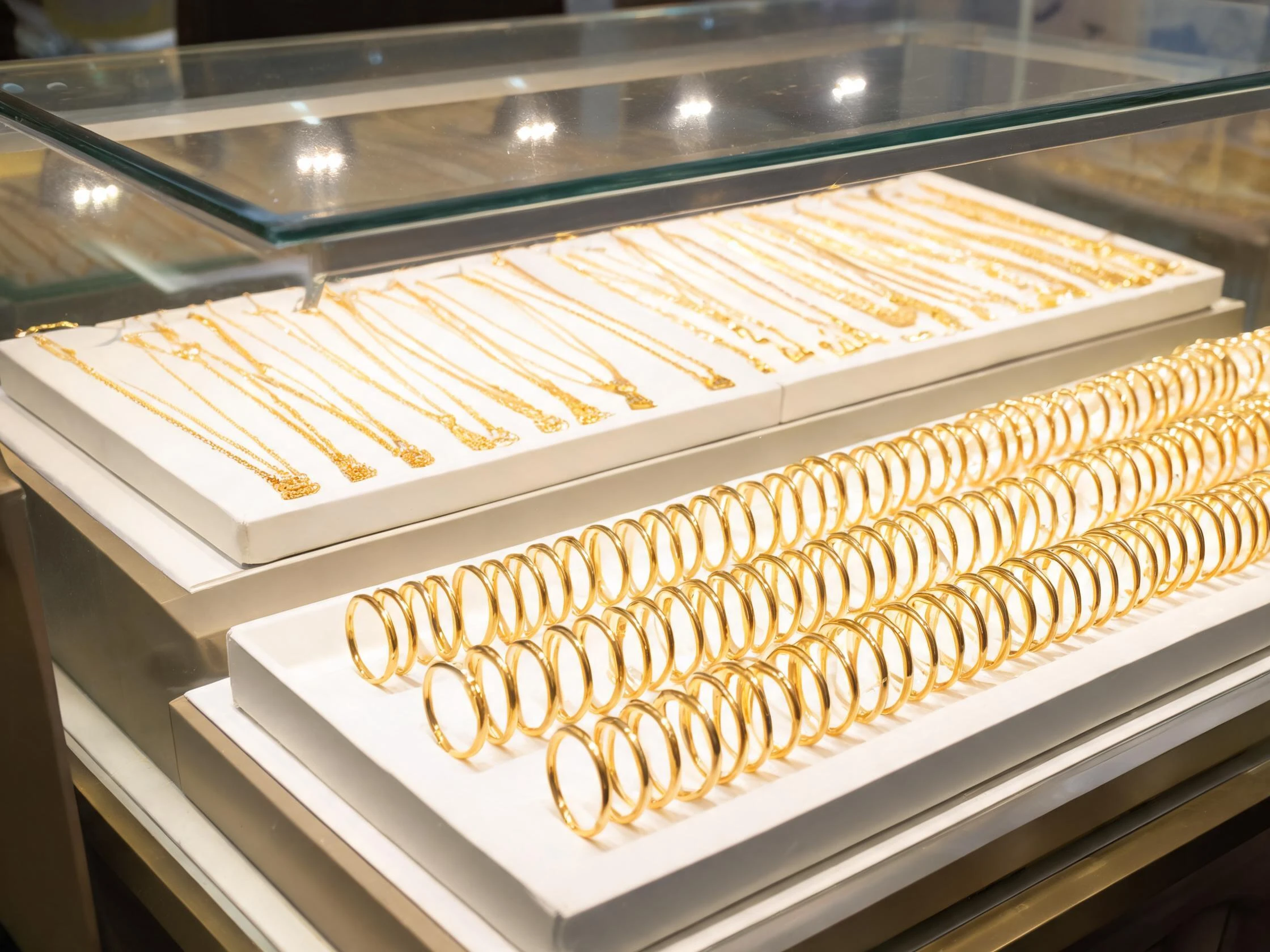
A jewelry display table with built-in tray wells handles all three ideas in one unit. For high-density gold programs, our gold chain store case study runs this layout across a full store.
What lighting sells jewelry best?
Case light roughly twice as bright as the room, and slightly cooler: 4000K inside the case against 3000K ambient, CRI 90 or higher. Backlit display counters are one of the most effective ways to make jewelry stand out — our JW-23 backlit counter project shows how top + back lighting can transform the look of a jewelry collection.
4. Lighted bases
An LED strip under the cabinet plinth lifts the whole unit off the floor and pulls eyes from the walkway. It costs little and works in any store format.
5. Hood spotlights
Concealed fittings inside the glass hood, aimed at the tray, not the glass. This is what makes stones sparkle. Skip it and even good inventory looks flat.
6. Backlit wall panels
Light the wall behind open shelving or niches to create a bright backdrop that silhouettes each piece.
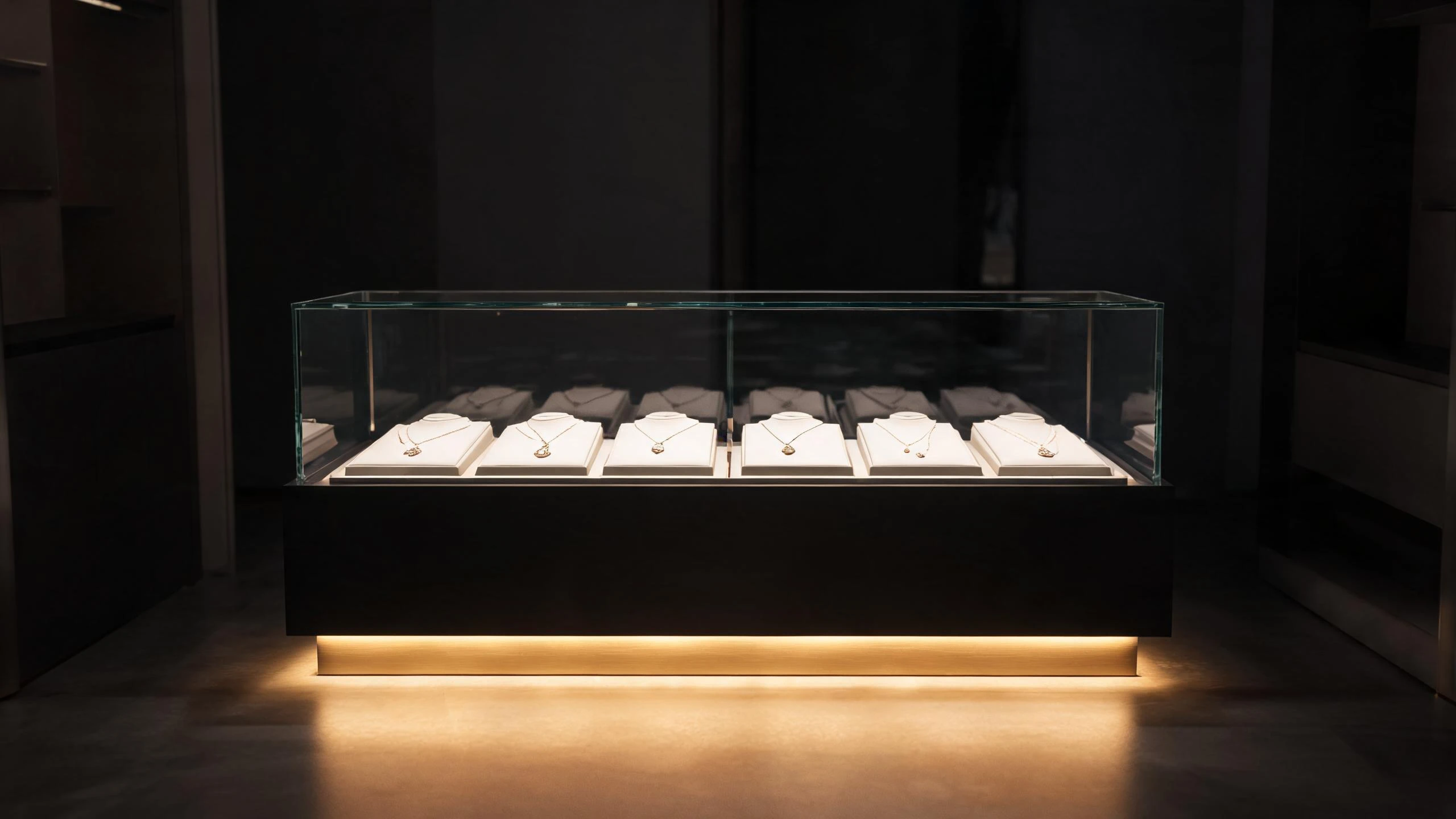
An LED jewelry display tower shows the spotlight setup in a tall format. We recently delivered a full store built on lighted bases; the lighted jewelry display cases project walks through the whole lighting plan.
When should displays go on the wall?
Whenever your floor is narrow. Perimeter runs add depth, and the window adds pull.
7. Perimeter glass runs
A row of straight counters along one wall turns dead space into selling space. Keep the run unbroken; separate units read as clutter.
8. Window towers
Tall glass towers in the window display your best three or four pieces to people who never walk in. Rotate the contents monthly.
9. Lit niches with busts
Recess a row of niches into the back wall, light each one, and stand a necklace bust inside. One bust per niche. This is the cheapest way to make a small store look curated.
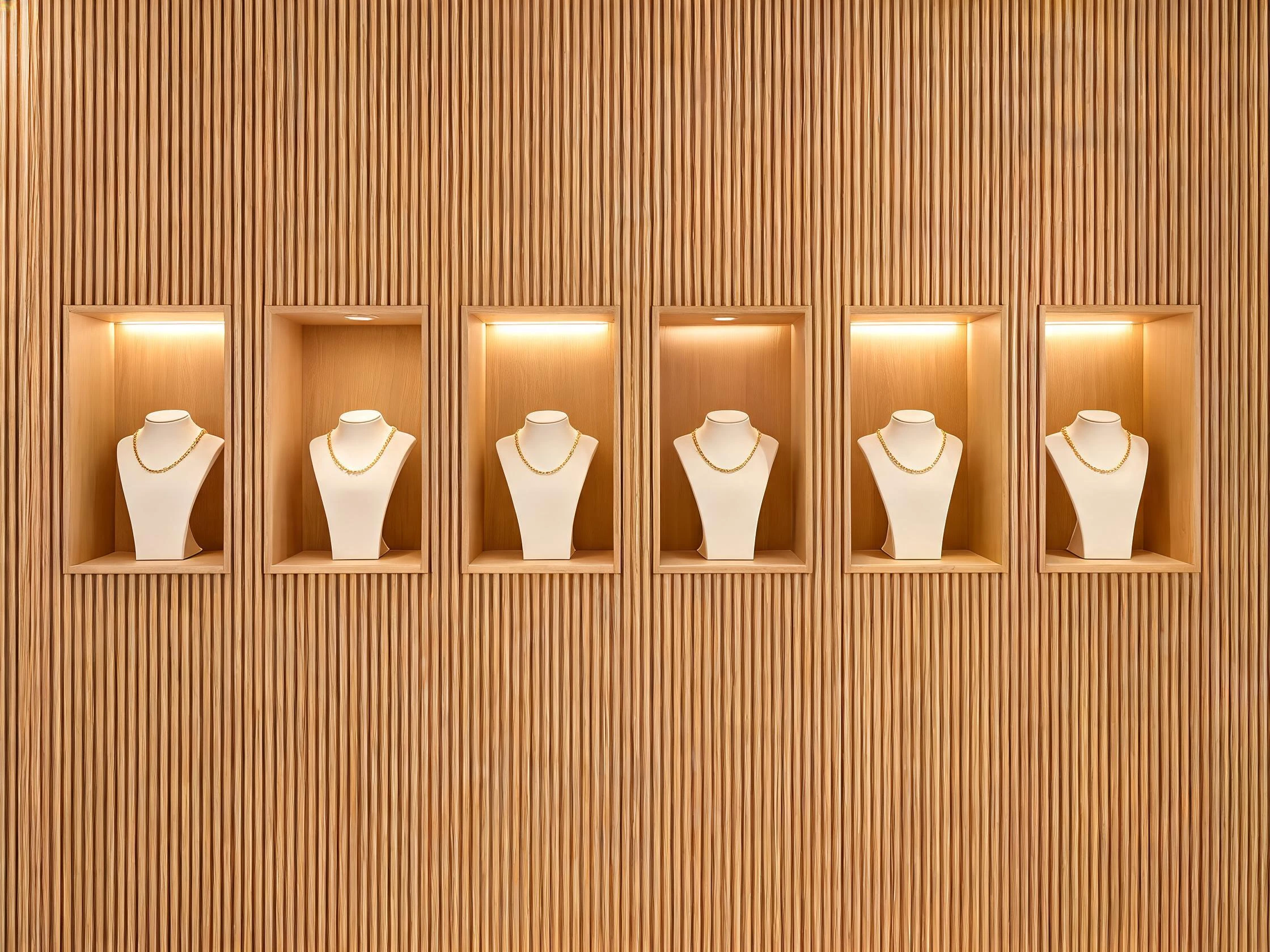
Our jewelry window display tower does the window job in a compact footprint. The wall-mounted display case project shows a full store built around the perimeter.
How do you make a hero piece stand out?
Isolation. One piece, one dome, nothing within arm’s reach.
10. Glass dome pedestals
A single ring or pendant under a glass dome, on a pedestal in the aisle. Customers walk around it, which is the point.
11. Museum vitrines
A tall, lockable glass cabinet for the one-of-one pieces. The museum format signals value before anyone reads a price tag.
12. Rotating plinths
A slow-turning base inside a vitrine catches light from every angle. Reserve it for your best cutter, not your whole line.
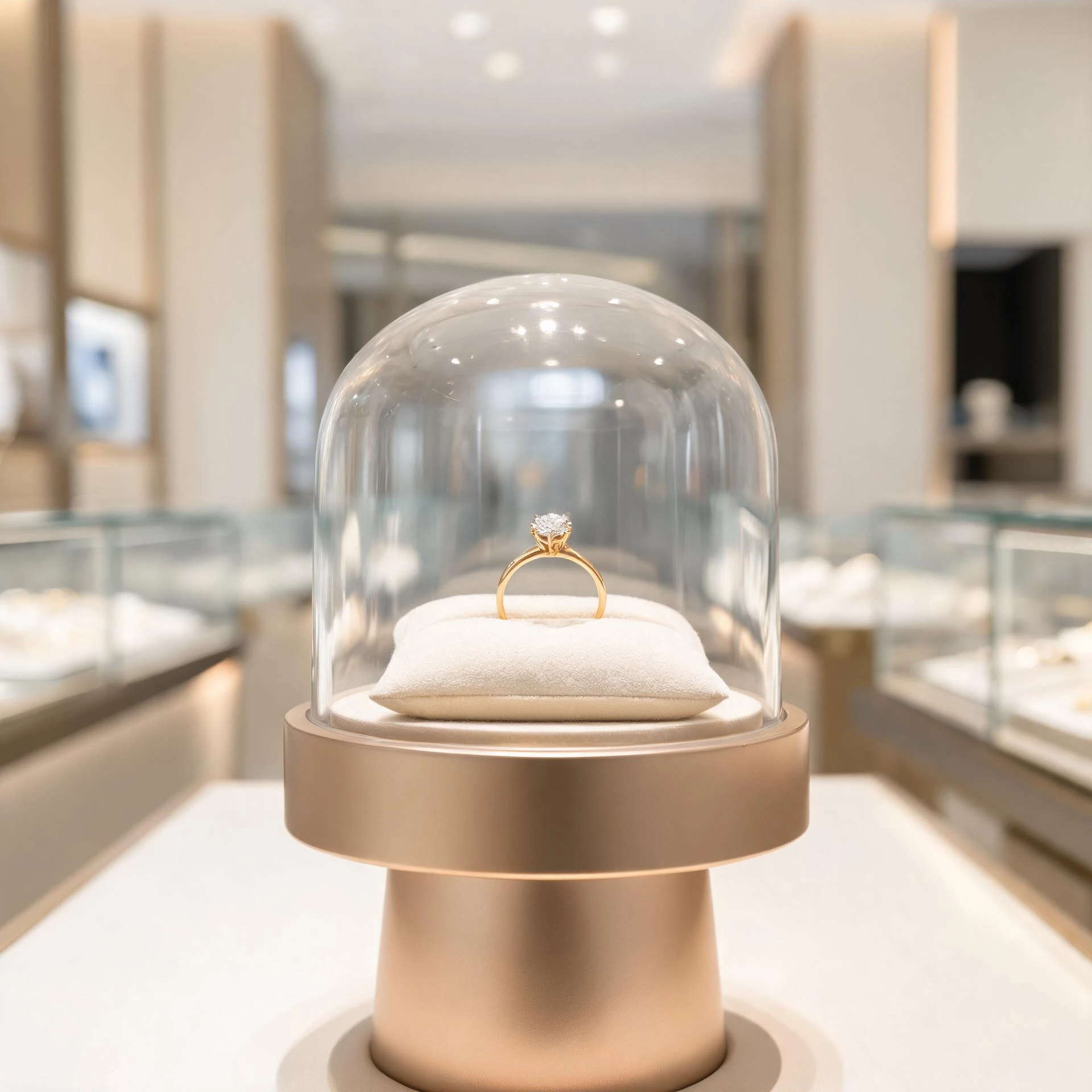
A dome jewelry pedestal covers idea 10 out of the box. For the vitrine route, see our jade display case project where a single vitrine anchors the whole store.
How do you protect high-value stock?
Lockable glass cases, laminated glass where it counts, and a floor plan where staff see every unit from anywhere in the store.
13. Lockable counters
Keyed or coded locks on every hood, with spare keys held off the floor. Unlocking should take a staff member two hands, and look like poor odds to anyone else. That layered approach is how the Jewelers’ Security Alliance — the trade’s crime-prevention body since 1883 — frames its advice.
14. Laminated glass and alarms
For a glass jewelry display case carrying high-value lines, specify laminated glass: struck, it stays in one piece, the glazing class the U.S. safety-glazing standard 16 CFR 1201 tests. Wire it to a local alarm. Contact alarms on hoods catch the smash-and-grab attempts that locks don’t.
The lockable jewelry display case project details a store built entirely around security, and our locking display table shows the format as a single unit.
What display works in a small store?
A compact island or a U-shaped run. Below about twenty square metres, aisles waste more floor than they earn.
15. Modular island kiosk
A small island with glass on four sides gives you display all the way around, and a wraparound counter doubles as service space. Mall concession floors and boutiques under 20 m² both run this format well.
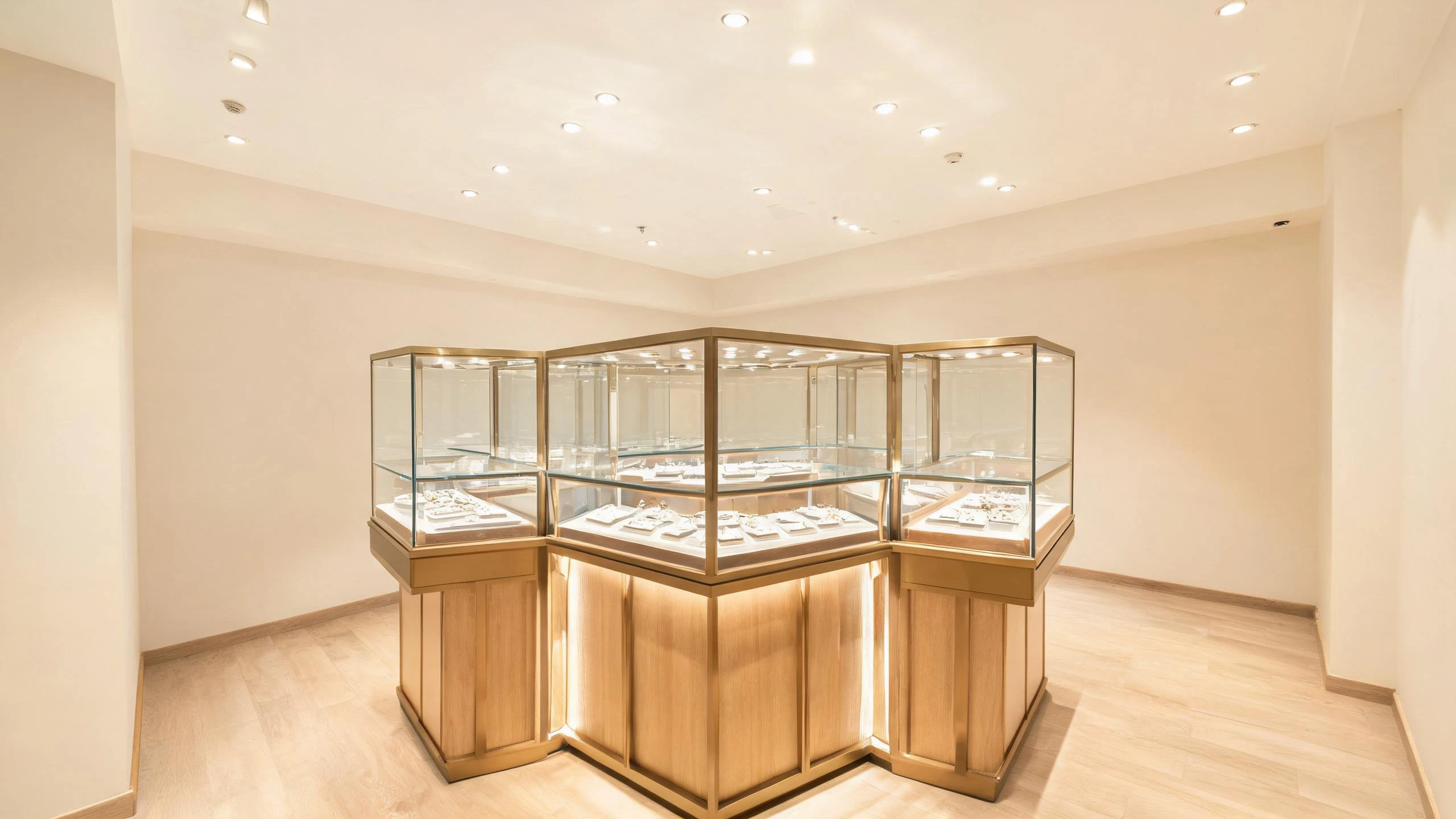
The modular jewelry island builds out from a centre column, so you can start with one ring of counters and add more later. Our custom jewelry kiosk project shows how far the format scales up.
FAQ
How tall should a jewelry counter be?
90–110 cm to the glass edge. That puts trays at standing eye level for most adults and gives staff a work surface at a comfortable height. Add 10–15 cm if your customers mostly sit during consultations.
How much does a custom display case cost?
Glass spec, lighting and locks move the price more than size does. Factory-direct single counters start in the low hundreds of dollars; a fitted island program for a full store runs into the thousands. Ask any supplier for an itemized quote covering glass type, lighting, locks and shipping. Expect a sample in 7–10 days and full production in 30–45 days.
What background color makes jewelry pop?
White and light-grey liners for gold and colored stones. Deep green or navy velvet for diamonds, because the dark field makes the sparkle carry. Avoid saturated colors near colored gemstones; the background tints the stone.
How many rings fit in one tray?
Standard slotted trays run 12–24 positions. Leave at least one slot open in each tray so the display reads as curated stock, not a bargain bin.
Run a store or a concession and want a second opinion on your layout? Tell us your floor size, product mix and a photo of the space. We’ll send back a layout plan with counter counts and an itemized quote. Sampling takes 7–10 days; full orders ship in 30–45.