Kostenloses Angebot anfordern
-
Tel/Whatsapp +86-13925899945
-
E-Mail: [email protected]






Wie viel kostet ein Mall-Kiosk? Die Fabrik- und Landed-Cost-Aufschlüsselung für 2026
Kostenaufschlüsselung für Mall-Kiosks 2026: FOB-Preisspannen, wie Mall-Vorschriften das Angebot verändern, Oktober-Frachtraten für USA/Europa, Einsparungen durch KD-Verpackung und die Kalkulation Kauf vs. Miete.
Wichtigste Erkenntnisse
- Ein individueller Mall-Kiosk kostet FOB vier- bis niedrige fünfstellige Beträge. Wer Ihnen eine feste Zahl nennt, bevor er Ihren Grundriss gesehen hat, rät.
- Elektroarbeiten, beleuchtete Beschilderung, ein Deckenbaldachin und die Einhaltung der Mall-Auflagen sind es, was einen Kiosk von einer gewöhnlichen Vitrine unterscheidet.
- Im Oktober 2026 kostete ein 40-Fuß-Container von China an die US-Westküste etwa $7.600–$8.300; derselbe Container nach Nordeuropa lag bei rund $3,300. Die Routen haben sich auseinanderentwickelt.
- Die Fracht kann den Preis eines einzelnen Kiosks in drei Situationen übersteigen: LCL-Versand, geringe Auslastung bei montierter Kistenverpackung und Routen in die USA zuzüglich Inlandstransport.
- KD-Flachverpackung kann die Stückzahl pro Container etwa verdoppeln. Das ist der größte Hebel auf Ihre Anlieferungskosten.
Inhaltsverzeichnis
- Warum eine Suche nach “Mall-Kiosk-Preis” Ihnen nutzlose Zahlen liefert
- Was kostet ein Mall-Kiosk ab Werk?
- Warum kostet ein Kiosk mehr als eine Vitrine?
- Wie verändern Mall-Vorschriften den Preis?
- Was kostete Seefracht im Oktober 2026?
- Wann ist die Fracht teurer als der Kiosk selbst?
- Was ist mit Zoll und Inlandslieferung?
- Mieten oder kaufen: der Break-even in einem Jahr mit hohen Frachtraten
- Wie liest man ein Kiosk-Angebot?
- Wie lange dauert ein individueller Kiosk?
- FAQ
- Holen Sie sich ein Landed-Cost-Angebot
Warum eine Suche nach “Mall-Kiosk-Preis” Ihnen nutzlose Zahlen liefert
Suchen Sie nach “Mall-Kiosk-Kosten”, erhalten Sie zwei Arten von Seiten: Marktplatz-Listings mit einer breiten Spanne und ohne Erklärung sowie Vermittler, die Mietverträge verkaufen. Keine davon sagt Ihnen, was Ihr Kiosk kostet, denn ein Kiosk ist kein Regalprodukt. Er ist ein kleines Gebäude, geformt um Ihre Marke, Ihren Produktmix und die Regeln einer bestimmten Mall.
Zwei Käufer können “einen Parfüm-Kiosk” anfragen und Angebote erhalten, die um den Faktor 3 auseinanderliegen. Der eine ist ein Standardtresen von 2 Metern; der andere ist eine vollständige Insel mit abgehängtem Baldachin, hinterleuchteten Nischen und einer Bodenplatte aus Stein. Dieser Leitfaden schlüsselt die Kosten so auf, wie eine Fabrik sie kalkuliert: Einheit, Compliance, Verpackung, Fracht und Zoll, unter Verwendung von Seefrachtraten, die im Oktober 2026 geprüft wurden. Er ergänzt unseren Einkaufszentrum-Kiosk Designleitfaden und unsere Aufschlüsselung dazu, wie viel eine individuelle Schmuckvitrine kostet. Wenn Sie die Kiosk-Kosten in einer Mall mit einem Laden an der Straßenfront vergleichen, rechnen Sie damit, dass die Mall-Version zusätzliche Elektro- und Compliance-Arbeiten mit sich bringt, bevor die erste Einheit versandt wird.
Was kostet ein Mall-Kiosk ab Werk?
Fabrikdirekte individuelle Kioske liegen in der Regel im vier- bis niedrigen fünfstelligen USD-Bereich pro Einheit, FOB Südchina. Die Spanne ist bewusst weit. Drei Dinge bewegen einen Kiosk durch diese Spanne:
- Standard-Thekenkiosk (etwa 2–3 qm). Korpus aus MDF oder Sperrholz, Vitrinen aus gehärtetem Glas, einfache LED-Streifen, kein Baldachin. Der günstigste Weg auf eine Mall-Fläche.
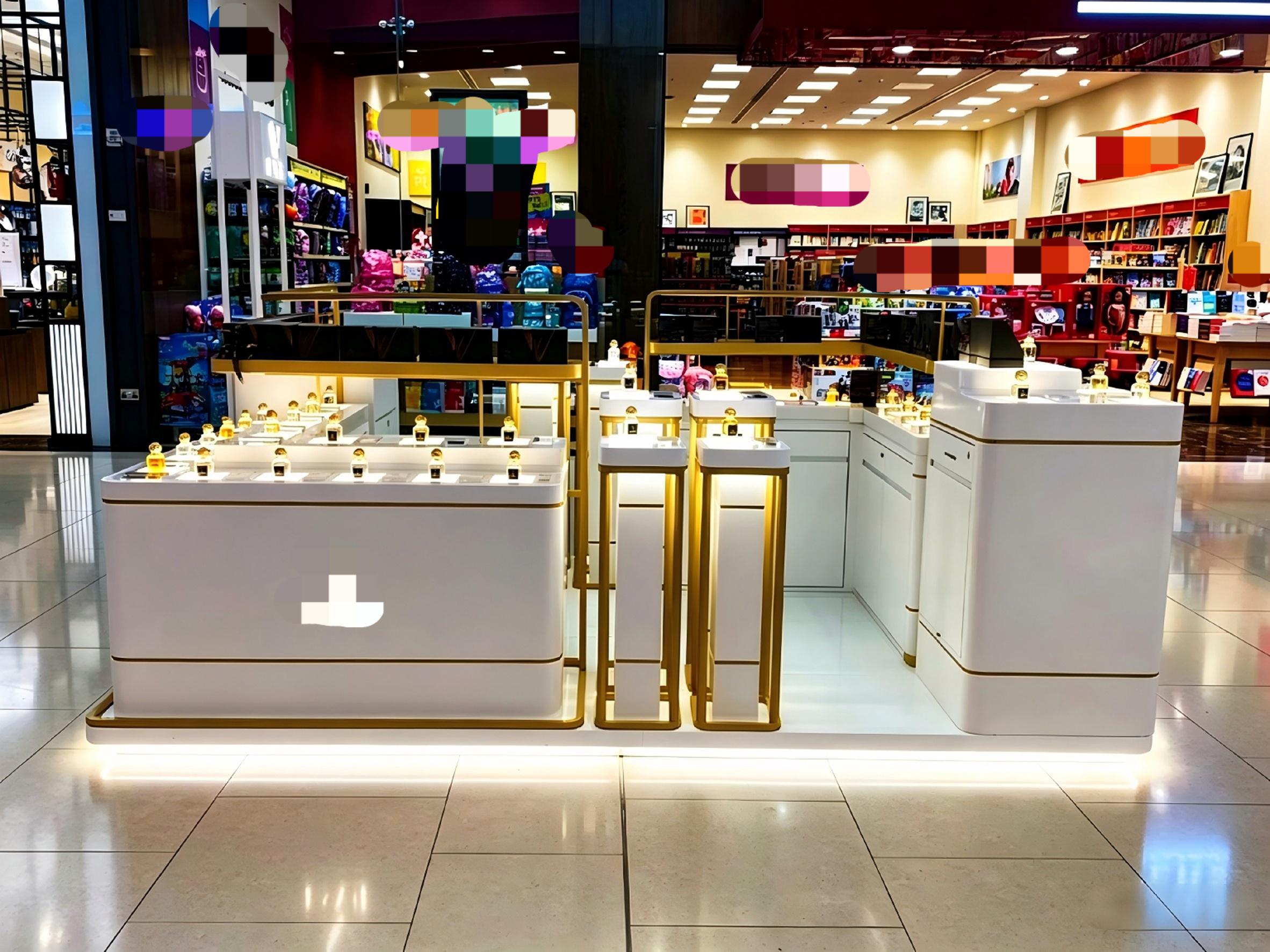
- Halbindividuelle Insel (etwa 4–6 qm). Gebrandete Blende und Lightbox-Schild, dichtere Beleuchtung, abgestufte Präsentationsflächen, eine Verkleidung oder Feature-Wand. Die meisten Beauty- und Parfüm-Programme liegen hier. Sehen Sie das Ausbauniveau in diesem Parfümkiosk oder Kosmetikkiosk.
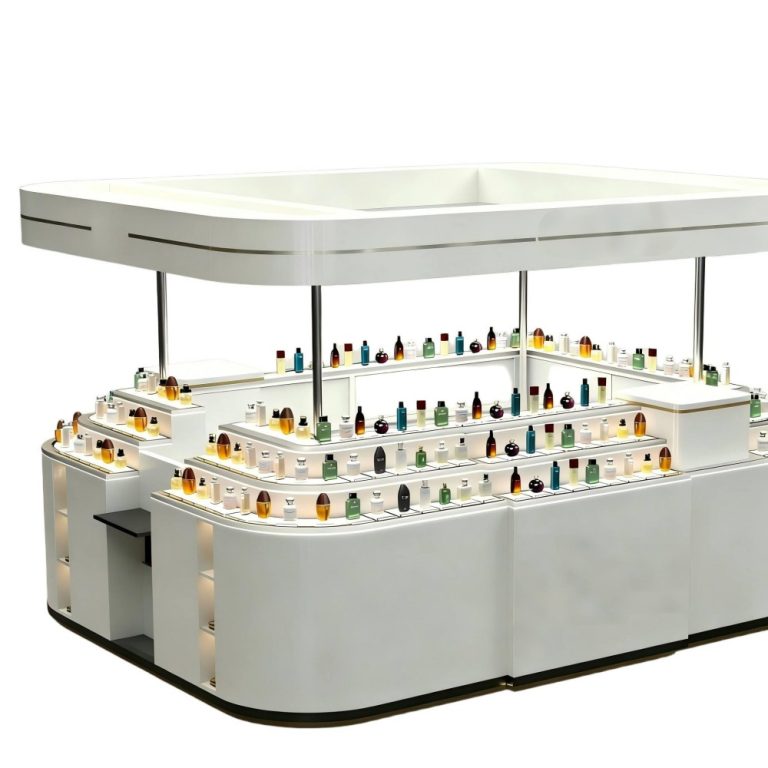
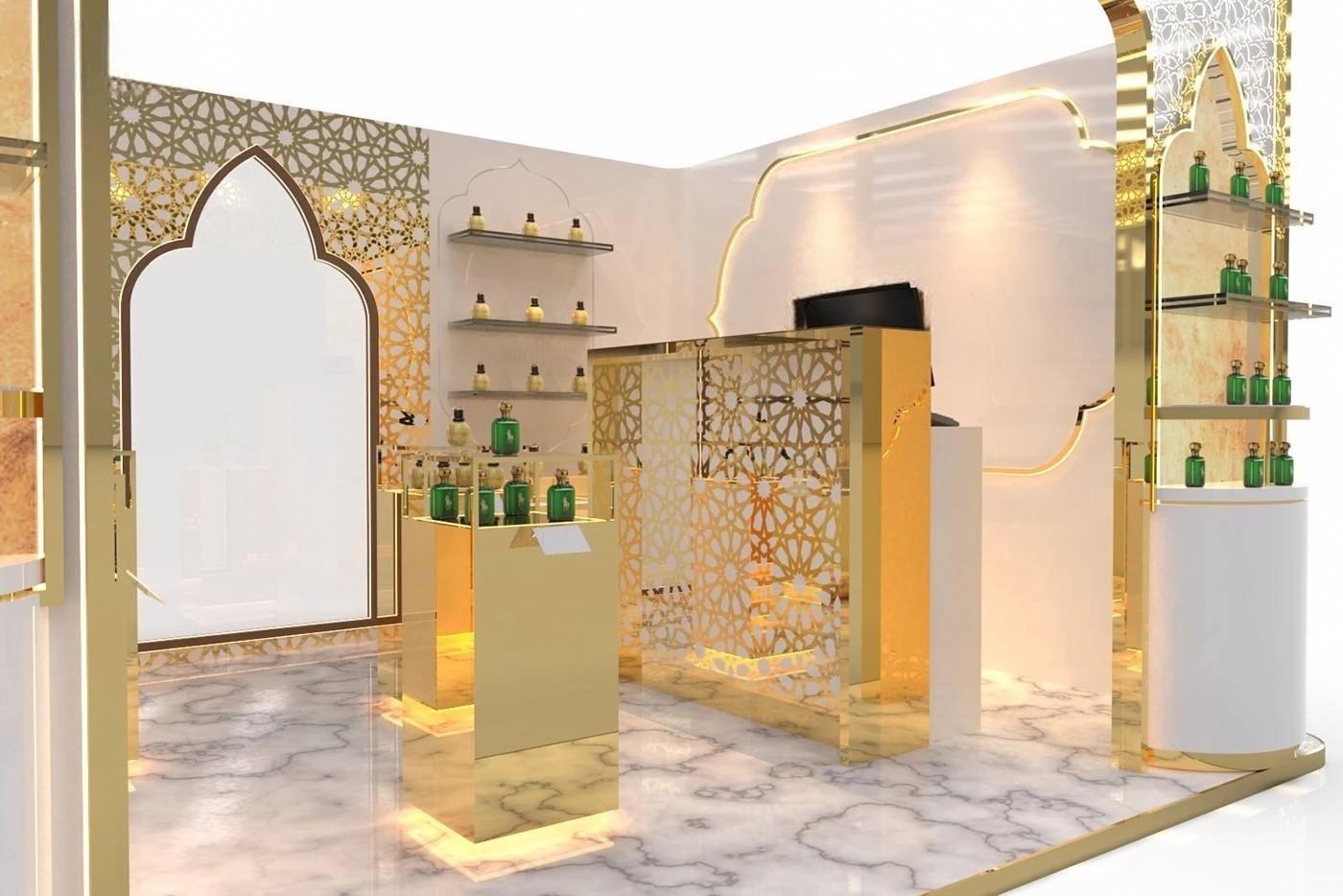
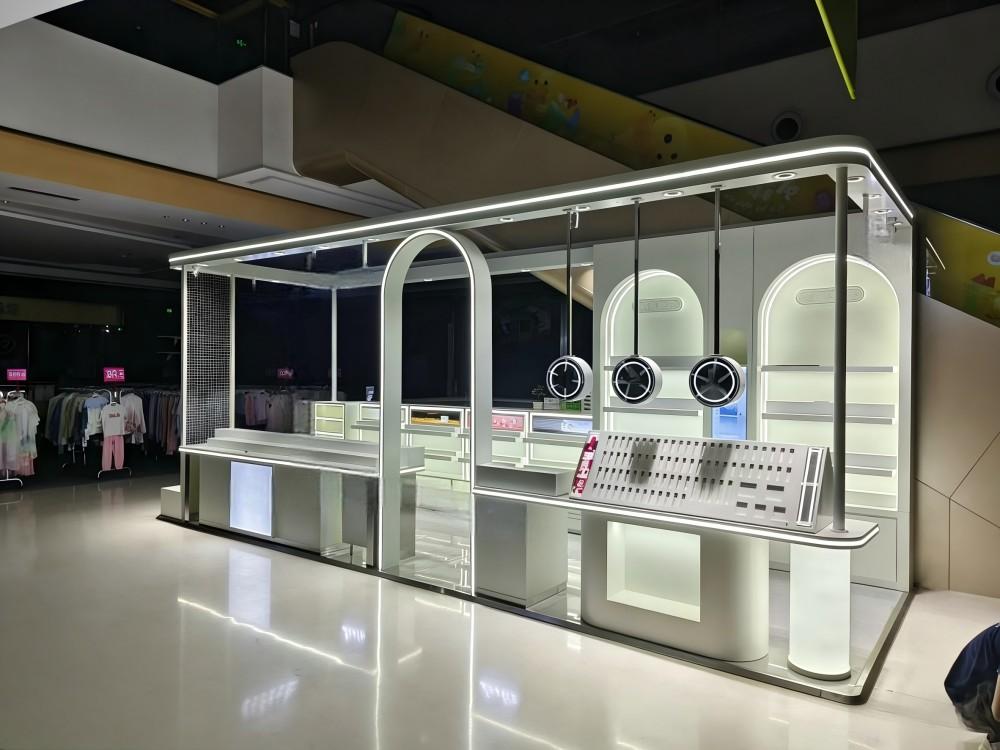
- Vollständiger Shop-in-Shop-Pavillon. Abgehängter Deckenrahmen, hinterleuchtete Nischen, Steintresen, mehrstufiger Boden und Sitzgelegenheiten. Diese Kategorie kommt einem Innenausbau näher als einem Möbelstück. Unsere individuellen Mall-Kiosk- Bauten zeigen, wie weit die Konstruktion geht.
Ein fester “Mall-Kiosk zu verkaufen”-Preis bedeutet fast immer ein Standard-Rendering ohne Elektro, Beschilderung, Fracht und Zoll. Echte Angebote beginnen bei Ihrem Grundriss und dem Kriterienblatt der Mall, ähnlich wie beim Vergleich der 7 Arten von Vitrinen: Das Kategorie-Etikett verbirgt den größten Teil der Kosten.
Warum kostet ein Kiosk mehr als eine Vitrine?
Eine Standvitrine ist eine Kiste mit Glas. Ein Kiosk ist ein eigenständiger Laden. Es gibt fünf Kostenpositionen, die ein Schrank nie benötigt:
- Elektrik und Beleuchtung. Malls verlangen zertifizierte Verkabelung, gekennzeichnete Stromkreise und zugängliche Anschlusspunkte. Dichte LED-Läufe, beleuchtete Regale und Tester-Stationen erhöhen Last, Teile und Arbeitsaufwand.
- Lightbox und Beschilderung. Blenden-Schilder, 3D-Logos und leuchtende Wegweiser werden markenspezifisch gefertigt, oft in mehreren Teilen.
- Deckenbaldachin und Struktur. Ein abgehängter oder säulengestützter Rahmen bedeutet Stahlbau, Transportverbindungen und Montage vor Ort.
- Glas und Beschläge. Gebogene oder übergroße Paneele, Schlösser und verstellbare Beschläge werden je nach Layout spezifiziert, nicht in Standardgrößen eingekauft.
- Mall-Compliance-Arbeiten. Drawings to the property manager’s standard, fire-rated materials and approval revisions. Boring to read about, expensive to skip.
Wie verändern Mall-Vorschriften den Preis?
The same drawing can pass in one mall and get rejected next door. Four rules do most of the damage:
- Power capacity and metering. Draw more than the bay’s allocated power and the mall bills you for an upgrade or separate meter. Lighting-heavy beauty and perfume programs hit this often.
- Fire codes and materials. North American malls commonly require fire-rated board, documented materials and sometimes third-party reports. Cheap substrate is off the table before cutting starts.
- Height, setback and sightlines. Height caps and corner setbacks shrink the canopy or force a sign redesign. Reachable counters also have to respect rules such as the ADA accessibility standards for forward reach.
- Floor loading and anchoring. Stone-clad kiosks may need weight documentation. Polished floors often ban drilling, forcing a freestanding, ballasted base.
A factory that has not asked for your criteria sheet by the second email plans to let you discover these costs on site.
Was kostete Seefracht im Oktober 2026?
Most “kiosk price” pages skip this chapter. In 2026 it is too big to skip. Spot rates for a 40-foot container (FEU), checked in the second week of October:
| Lane | Indicator | Rate per FEU | Trend |
|---|---|---|---|
| China → U.S. West Coast | Freightos FBX01 | ~$8,149 | +4% on the week |
| Shanghai → Los Angeles | Drewry WCI | $7,624 | easing slightly |
| Shanghai → New York | Drewry WCI | $10,220 | near record territory |
| Shanghai → Rotterdam | Drewry WCI | $3,337 | 13 weeks of declines |
Sources: Freightos Baltic Index FBX01, der Drewry World Container Index, and the Shanghai Containerized Freight Index, whose settled index for the week of October 12 rose 11.4% on the U.S. West lane and fell 6.1% on Europe. The indices update weekly, so read the table as an anchor, not a quote.
Transpacific rates stayed high through Golden Week on tight capacity, while Asia–Europe fell as carriers returned to the Red Sea; the Premier Alliance announced its return on October 6. Routing is not guaranteed either: some services still sail via the Cape of Good Hope, adding about 10–14 days. Confirm the actual routing at booking, not at pickup.
Wann ist die Fracht teurer als der Kiosk selbst?
“Shipping cost more than the goods” is a real 2026 complaint. It happens in three specific situations, and all three are avoidable:
- LCL, one kiosk. A single crate moving less-than-container-load is charged by volume with handling minimums. On U.S. lanes its share can rival a lower-tier kiosk’s FOB price.
- Assembled crating with low load factor. A built-up canopy kiosk crated whole wastes most of the container’s cube. One kiosk in a $7,600 box is an expensive kiosk.
- U.S. lane plus inland leg. Drayage from the West Coast port, or the roughly $2,600 gap between West and East Coast routings, plus trucking to an inland mall, stacks on top of ocean freight.
Four levers cut the freight per unit:
- KD flat packing. The kiosk is built as panels and assemblies that bolt on site. Crates stack and nest, often loading about twice as many units per container as assembled crating. This is a design decision made before production, not a warehouse trick.
- Fill the container. Coordinate with a partner store, or add accessories and showcases to the same shipment. A full FEU of KD kiosks costs a fraction per unit of a solo LCL crate.
- Choose the port. Sites west of the Rockies should not default to East Coast routing. In Europe, base ports like Rotterdam and Hamburg are far cheaper than the U.S. lanes right now.
- Time the order. A factory that can hold finished, packed goods for a named sailing week lets you book on purpose instead of panic-booking.
Was ist mit Zoll und Inlandslieferung?
Store fixtures and furniture of this type usually fall under HTS heading 9403 in the U.S. tariff; look up the chapter on the USITC HTS search. The actual rate depends on material and origin and moves with trade policy, so no honest article prints a fixed percentage. Get the classification in writing on the proforma invoice and confirm the rate with your customs broker.
After customs comes drayage or rail to the inland hub, trucking to the mall dock, and storage if the load misses a booked window. Same structure as our retail checkout counter programs: the unit is predictable; the last mile is where budgets break.
Mieten oder kaufen: der Break-even in einem Jahr mit hohen Frachtraten
Rental listings dominate this search. Do the math rather than assume. Compare:
- Lease: monthly rent × term, plus deposit, insurance and restoration fees, with no asset at the end.
- Buy (imported KD): unit price, packed freight per unit, duty and installation, minus residual value. Imported units move to your next location; a leased build does not.
A single-site test under about 12 months, in one city, often favors leasing once freight and management fees are loaded in. Multiple locations, a reusable design, or any term past two years usually favors buying: freight is paid once and the kiosk moves with you. Pilot with one retail kiosk for sale and replicate it; engineering and setup costs do not repeat.
Wie liest man ein Kiosk-Angebot?
A usable quote separates at least six lines. If yours bundles them into one number, ask for the split:
- Kiosk body and finishes
- Electrical package and lighting
- Signage and lightboxes
- KD packing method and units per 40HQ container
- Freight and duty, or a clear “FOB only, freight excluded” statement
- Lead time and the quote’s validity date
Line 4 is the one buyers forget, and it decides your landed cost in 2026. Real projects show the range: compare a compact jewelry kiosk, a near-standard Mall-Kiosks zum Verkauf, a full jewelry kiosk in a mall case study, or a sector next door such as the bakery display cases RS-05 project und des makeup kiosk BS-12 case study.
Wie lange dauert ein individueller Kiosk?
Plan for 7–10 days of drawings, including mall approval cycles, then 30–45 days of production. Ocean transit runs about 14–18 days to the U.S. West Coast and 30–35 days to Northern Europe via Suez, plus 10–14 days via the Cape. Work backward from the move-in date: the approval back-and-forth, not the factory, is what usually makes a kiosk late. See the current Einkaufszentrum-Kioske range for packing configurations.
FAQ
How much does the average mall kiosk cost?
Four figures to low five figures FOB, depending on size, electrical load, signage and canopy work. “Average” prices without a specification are marketing numbers, not quotes.
Why is ocean freight so expensive in 2026?
Transpacific capacity stayed tight through peak season, with China to U.S. West Coast FEU rates around $7,600–$8,300 in October. Asia–Europe fell toward $3,300 as Red Sea transits resumed. Rates move weekly, which is why packing and container fill matter more than chasing one sailing.
Can shipping really cost more than the kiosk?
Yes, for a single assembled kiosk shipped LCL to a U.S. destination with inland trucking. Not for a full container of KD-packed units, where freight per kiosk drops hard.
Do I have to assemble a KD kiosk myself?
KD kiosks go together with numbered panels and a manual. Most buyers use a local handyman or the mall’s approved contractor; an island usually takes one to two days. We supply drawings and remote support.
Is it cheaper to lease a mall kiosk or buy one?
A short single-site test under about a year can favor leasing once fees and freight are counted. Multi-site rollouts, reusable designs or terms over two years usually favor buying: freight is paid once and the unit relocates with you.
What information do I need for an accurate quote?
Your floor plan or bay dimensions, the mall’s criteria sheet (power, height, fire and signage rules), product categories, destination port and move-in date. With those, a factory can quote unit plus landed cost instead of guessing.
Holen Sie sich ein Landed-Cost-Angebot
A kiosk budget built only on the sticker price is how buyers get burned. Send your floor plan, mall criteria sheet and destination port, and we will quote a kiosk built to fit, with unit, electrical, signage, KD packing, units per container, ocean freight and duty broken out line by line. Request your landed-cost quote, or compare designs first in the full Einkaufszentrum-Kioske collection.