免費取得報價
-
電話/WhatsApp +86-13925899945
-
電子郵件: [email protected]








How Much Does a Mall Kiosk Cost? The 2026 Factory and Landed-Cost Breakdown
2026 mall kiosk cost breakdown: FOB price ranges, how mall rules change the quote, October US/Europe freight rates, KD packing savings and buy vs lease math.
關鍵要點
- A custom mall kiosk runs four figures to low five figures FOB. Anyone who gives you a fixed number before seeing your floor plan is guessing.
- Electrical work, illuminated signage, a ceiling canopy and mall-compliance engineering are what separate a kiosk from an ordinary showcase.
- In October 2026 a 40-foot container from China to the U.S. West Coast ran about $7,600–$8,300; the same box to Northern Europe was around $3,300. The lanes have diverged.
- Freight can exceed the price of a single kiosk in three situations: LCL shipping, low load factor in assembled crating, and U.S.-bound lanes plus inland trucking.
- KD flat packing can roughly double the units per container. It is the biggest lever on your delivered cost.
目錄
- Why a “mall kiosk price” search gives you useless numbers
- How much does a mall kiosk cost at the factory?
- Why does a kiosk cost more than a display case?
- How do mall rules change the price?
- What did ocean freight cost in October 2026?
- When is freight higher than the kiosk itself?
- What about duty and inland delivery?
- Lease or buy: the break-even in a high-freight year
- How do you read a kiosk quote?
- How long does a custom kiosk take?
- 常見問題
- Get a landed-cost quote
Why a “mall kiosk price” search gives you useless numbers
Search for “mall kiosk cost” and you get two kinds of pages: marketplace listings with a wide range and no explanation, and rental brokers selling leases. Neither tells you what your kiosk costs, because a kiosk is not a shelf product. It is a small building shaped around your brand, product mix and the rules of one mall.
Two buyers can ask for “a perfume kiosk” and receive quotes 3x apart. One is a 2-meter standard counter; the other is a full island with a suspended canopy, backlit niches and a stone floor plate. This guide breaks the cost the way a factory prices it: unit, compliance, packing, freight and duty, using ocean rates checked in October 2026. It pairs with our 購物中心攤位 design guide and our breakdown of how much a custom jewelry display case costs. If you are comparing the kiosk cost in a mall against a street-front shop, expect the mall version to carry extra electrical and compliance work before the first unit ships.
How much does a mall kiosk cost at the factory?
Factory-direct custom kiosks generally land in the four-figure to low-five-figure USD range per unit, FOB South China. The band is wide on purpose. Three things move a kiosk through it:
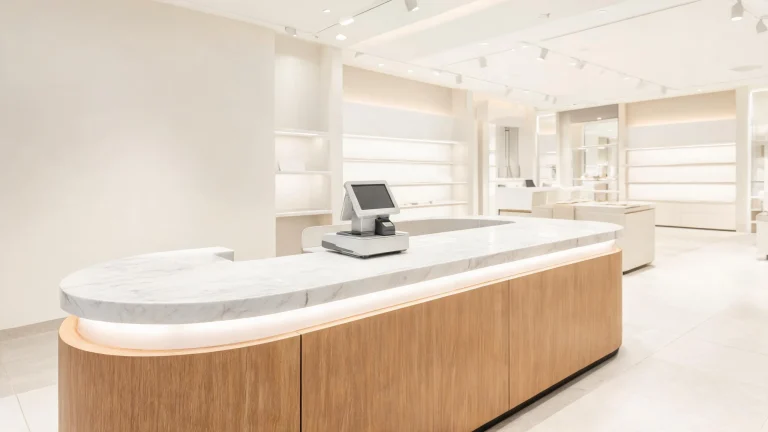
- Standard counter kiosk (about 2–3 sqm). MDF or plywood body, tempered glass showcases, basic LED strips, no canopy. The cheapest path onto a mall floor.
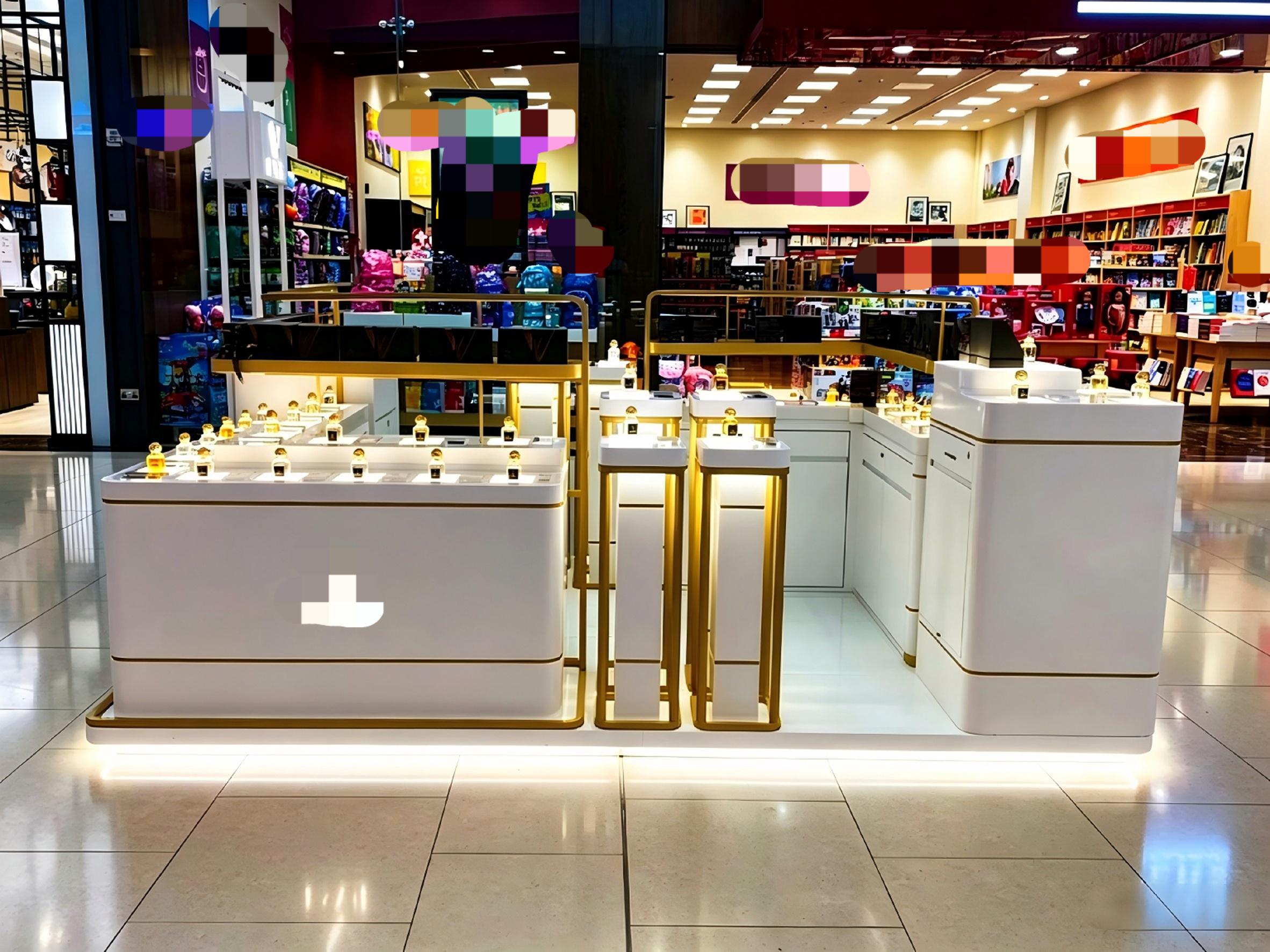
- Semi-custom island (about 4–6 sqm). Branded fascia and lightbox sign, denser lighting, stepped display decks, a wrap or feature wall. Most beauty and perfume programs sit here. See the build level in this 香水櫃位 or 化妝品櫃位.
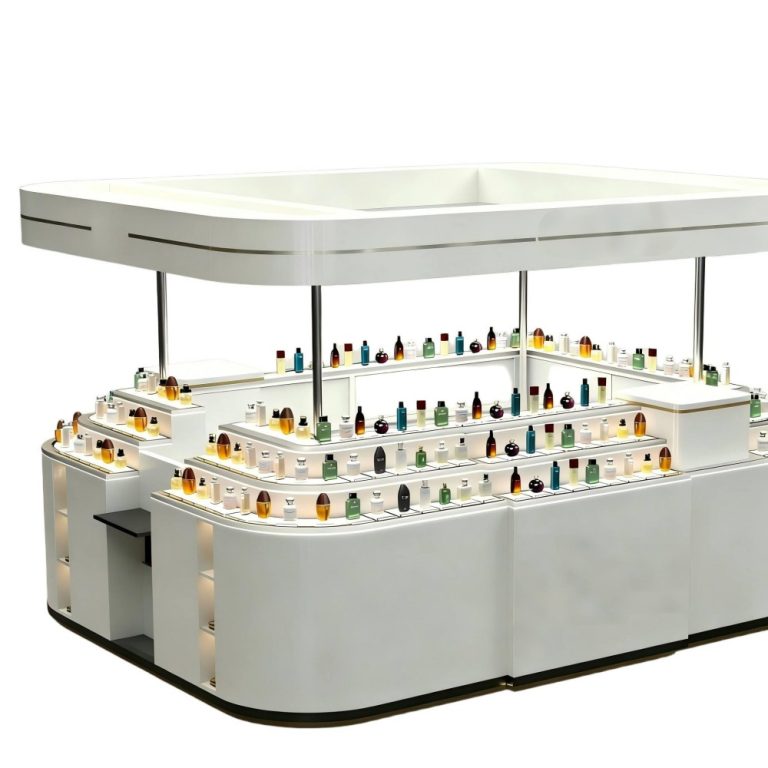
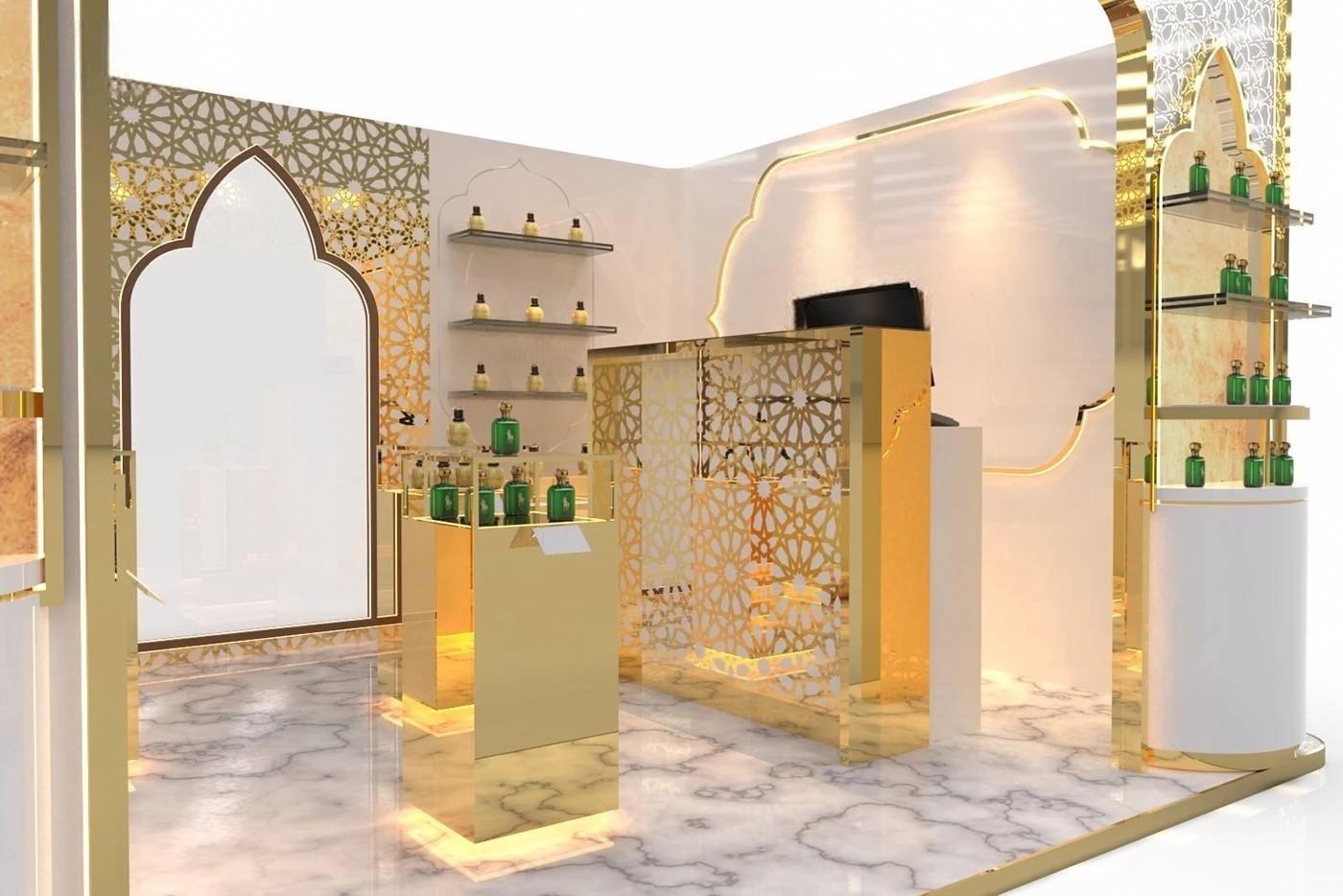
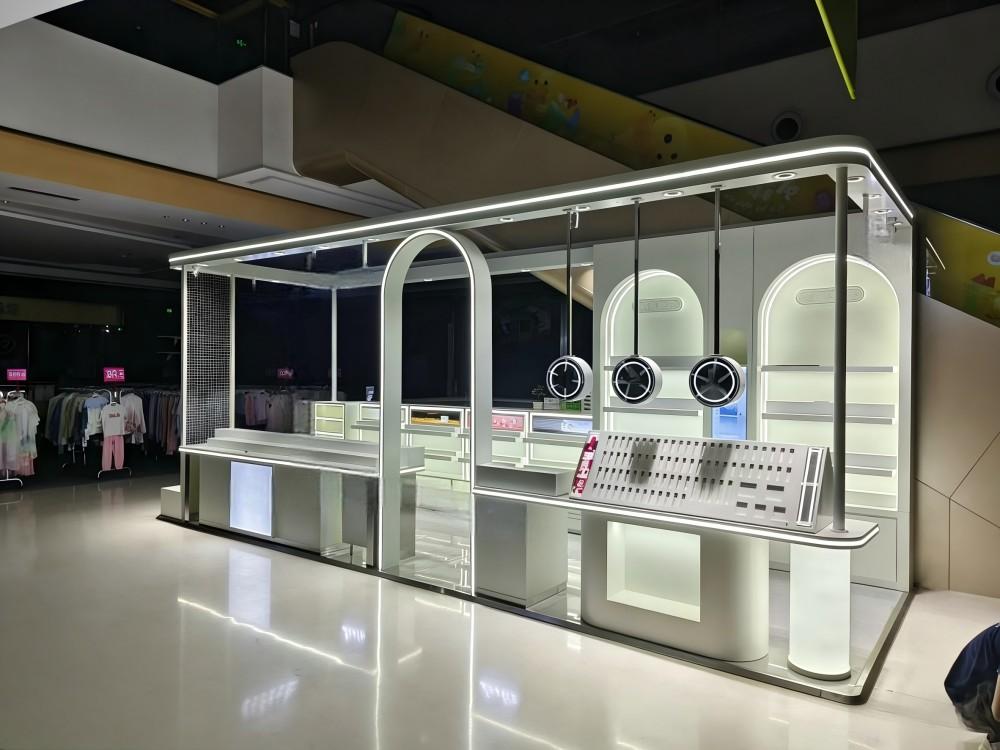
- Full shop-in-shop pavilion. Suspended ceiling frame, backlit niches, stone counters, multi-level flooring and seating. This category is closer to interior fit-out than furniture. Our custom mall kiosk builds show how far the structure goes.
A fixed “mall kiosk for sale” price almost always means one standard render with electrical, signage, freight and duty excluded. Real quotes start from your floor plan and the mall’s criteria sheet, much like comparing the 7 types of display cases: the category label hides most of the cost.
Why does a kiosk cost more than a display case?
A floor-standing showcase is a box with glass. A kiosk is a self-contained shop. Five cost lines exist that a cabinet never needs:
- Electrical and lighting. Malls require certified wiring, labeled circuits and accessible junctions. Dense LED runs, lit shelves and tester stations add load, parts and labor.
- Lightbox and signage. Fascia signs, 3D logos and glowing signposts are fabricated per brand, often in several pieces.
- Ceiling canopy and structure. A suspended or column-supported frame means steelwork, transport joints and on-site assembly.
- Glass and hardware. Curved or oversized panels, locks and adjustable hardware are specified per layout, not bought in standard sizes.
- Mall compliance work. Drawings to the property manager’s standard, fire-rated materials and approval revisions. Boring to read about, expensive to skip.
How do mall rules change the price?
The same drawing can pass in one mall and get rejected next door. Four rules do most of the damage:
- Power capacity and metering. Draw more than the bay’s allocated power and the mall bills you for an upgrade or separate meter. Lighting-heavy beauty and perfume programs hit this often.
- Fire codes and materials. North American malls commonly require fire-rated board, documented materials and sometimes third-party reports. Cheap substrate is off the table before cutting starts.
- Height, setback and sightlines. Height caps and corner setbacks shrink the canopy or force a sign redesign. Reachable counters also have to respect rules such as the ADA accessibility standards for forward reach.
- Floor loading and anchoring. Stone-clad kiosks may need weight documentation. Polished floors often ban drilling, forcing a freestanding, ballasted base.
A factory that has not asked for your criteria sheet by the second email plans to let you discover these costs on site.
What did ocean freight cost in October 2026?
Most “kiosk price” pages skip this chapter. In 2026 it is too big to skip. Spot rates for a 40-foot container (FEU), checked in the second week of October:
| Lane | Indicator | Rate per FEU | Trend |
|---|---|---|---|
| China → U.S. West Coast | Freightos FBX01 | ~$8,149 | +4% on the week |
| Shanghai → Los Angeles | Drewry WCI | $7,624 | easing slightly |
| Shanghai → New York | Drewry WCI | $10,220 | near record territory |
| Shanghai → Rotterdam | Drewry WCI | $3,337 | 13 weeks of declines |
Sources: Freightos Baltic Index FBX01, 、 Drewry World Container Index, and the Shanghai Containerized Freight Index, whose settled index for the week of October 12 rose 11.4% on the U.S. West lane and fell 6.1% on Europe. The indices update weekly, so read the table as an anchor, not a quote.
Transpacific rates stayed high through Golden Week on tight capacity, while Asia–Europe fell as carriers returned to the Red Sea; the Premier Alliance announced its return on October 6. Routing is not guaranteed either: some services still sail via the Cape of Good Hope, adding about 10–14 days. Confirm the actual routing at booking, not at pickup.
When is freight higher than the kiosk itself?
“Shipping cost more than the goods” is a real 2026 complaint. It happens in three specific situations, and all three are avoidable:
- LCL, one kiosk. A single crate moving less-than-container-load is charged by volume with handling minimums. On U.S. lanes its share can rival a lower-tier kiosk’s FOB price.
- Assembled crating with low load factor. A built-up canopy kiosk crated whole wastes most of the container’s cube. One kiosk in a $7,600 box is an expensive kiosk.
- U.S. lane plus inland leg. Drayage from the West Coast port, or the roughly $2,600 gap between West and East Coast routings, plus trucking to an inland mall, stacks on top of ocean freight.
Four levers cut the freight per unit:
- KD flat packing. The kiosk is built as panels and assemblies that bolt on site. Crates stack and nest, often loading about twice as many units per container as assembled crating. This is a design decision made before production, not a warehouse trick.
- Fill the container. Coordinate with a partner store, or add accessories and showcases to the same shipment. A full FEU of KD kiosks costs a fraction per unit of a solo LCL crate.
- Choose the port. Sites west of the Rockies should not default to East Coast routing. In Europe, base ports like Rotterdam and Hamburg are far cheaper than the U.S. lanes right now.
- Time the order. A factory that can hold finished, packed goods for a named sailing week lets you book on purpose instead of panic-booking.
What about duty and inland delivery?
Store fixtures and furniture of this type usually fall under HTS heading 9403 in the U.S. tariff; look up the chapter on the USITC HTS search. The actual rate depends on material and origin and moves with trade policy, so no honest article prints a fixed percentage. Get the classification in writing on the proforma invoice and confirm the rate with your customs broker.
After customs comes drayage or rail to the inland hub, trucking to the mall dock, and storage if the load misses a booked window. Same structure as our retail checkout counter programs: the unit is predictable; the last mile is where budgets break.
Lease or buy: the break-even in a high-freight year
Rental listings dominate this search. Do the math rather than assume. Compare:
- Lease: monthly rent × term, plus deposit, insurance and restoration fees, with no asset at the end.
- Buy (imported KD): unit price, packed freight per unit, duty and installation, minus residual value. Imported units move to your next location; a leased build does not.
A single-site test under about 12 months, in one city, often favors leasing once freight and management fees are loaded in. Multiple locations, a reusable design, or any term past two years usually favors buying: freight is paid once and the kiosk moves with you. Pilot with one retail kiosk for sale and replicate it; engineering and setup costs do not repeat.
How do you read a kiosk quote?
A usable quote separates at least six lines. If yours bundles them into one number, ask for the split:
- Kiosk body and finishes
- Electrical package and lighting
- Signage and lightboxes
- KD packing method and units per 40HQ container
- Freight and duty, or a clear “FOB only, freight excluded” statement
- Lead time and the quote’s validity date
Line 4 is the one buyers forget, and it decides your landed cost in 2026. Real projects show the range: compare a compact jewelry kiosk, a near-standard 商場售貨亭出售, a full jewelry kiosk in a mall case study, or a sector next door such as the bakery display cases RS-05 project 和 makeup kiosk BS-12 case study.
How long does a custom kiosk take?
Plan for 7–10 days of drawings, including mall approval cycles, then 30–45 days of production. Ocean transit runs about 14–18 days to the U.S. West Coast and 30–35 days to Northern Europe via Suez, plus 10–14 days via the Cape. Work backward from the move-in date: the approval back-and-forth, not the factory, is what usually makes a kiosk late. See the current 商場中島櫃 range for packing configurations.
常見問題
How much does the average mall kiosk cost?
Four figures to low five figures FOB, depending on size, electrical load, signage and canopy work. “Average” prices without a specification are marketing numbers, not quotes.
Why is ocean freight so expensive in 2026?
Transpacific capacity stayed tight through peak season, with China to U.S. West Coast FEU rates around $7,600–$8,300 in October. Asia–Europe fell toward $3,300 as Red Sea transits resumed. Rates move weekly, which is why packing and container fill matter more than chasing one sailing.
Can shipping really cost more than the kiosk?
Yes, for a single assembled kiosk shipped LCL to a U.S. destination with inland trucking. Not for a full container of KD-packed units, where freight per kiosk drops hard.
Do I have to assemble a KD kiosk myself?
KD kiosks go together with numbered panels and a manual. Most buyers use a local handyman or the mall’s approved contractor; an island usually takes one to two days. We supply drawings and remote support.
Is it cheaper to lease a mall kiosk or buy one?
A short single-site test under about a year can favor leasing once fees and freight are counted. Multi-site rollouts, reusable designs or terms over two years usually favor buying: freight is paid once and the unit relocates with you.
What information do I need for an accurate quote?
Your floor plan or bay dimensions, the mall’s criteria sheet (power, height, fire and signage rules), product categories, destination port and move-in date. With those, a factory can quote unit plus landed cost instead of guessing.
Get a landed-cost quote
A kiosk budget built only on the sticker price is how buyers get burned. Send your floor plan, mall criteria sheet and destination port, and we will quote a kiosk built to fit, with unit, electrical, signage, KD packing, units per container, ocean freight and duty broken out line by line. Request your landed-cost quote, or compare designs first in the full 商場中島櫃 collection.