Get Free Quote
-
Tel/Whatsapp +86-13925899945
-
Email: info@showcasecabinet.com








Jewelry Display Case Buyer’s Guide: How to Choose the Right One
A practical buyer's guide to jewelry display cases — materials, lighting, glass, security, custom vs standard, and how to choose the right manufacturer.
Table of Contents
- Key Takeaways
- Introduction
- Step 1: Figure Out What You Actually Need
- Step 2: Choose the Right Material
- Step 3: Get the Lighting Right
- Step 4: Pick the Right Glass
- Step 5: Security and Locks
- Step 6: Custom vs. Standard
- Step 7: Choose a Manufacturer
- Step 8: The Process Timeline
- Frequently Asked Questions
- Ready to Start Your Project?
Key Takeaways
- The right display case doesn’t just hold jewelry — it shapes how customers perceive value and what they end up buying.
- Material, lighting, glass quality, and security are the four decisions that matter most. Size and finish come after.
- Tempered safety glass is non-negotiable for retail. It’s required under U.S. safety-glazing standards and breaks into small, safe pieces if it fails.
- For diamonds and colored stones, 3000K warm white with CRI ≥ 90 is the standard. Good lighting directly improves sell-through.
- Factory direct saves 30–50% compared to retail fixture middlemen, with full control over customization.
- Start with a floor plan or sketch — a good factory will give you a free 3D design and quote.
—
Introduction
Buying jewelry display cases isn’t complicated, but there are a lot of small decisions that add up. Get them right and your cases will make the merchandise look better, sell faster, and last for years. Get them wrong and you’ll be dealing with foggy glass, burned-out LEDs, and fixtures that don’t fit your space.
This guide walks through what matters, what doesn’t, and how to tell a good manufacturer from a bad one. It’s built around factory production reality, not marketing copy — so you can buy with confidence.
—
Step 1: Figure Out What You Actually Need
Before you start comparing materials or finishes, get clear on the basics.
Size and Layout
Measure your space. Note wall lengths, door positions, columns, and any irregular corners. Custom cases are built to exact dimensions, so the more accurate your measurements, the better the fit.
Most jewelry stores use a mix of:
- **Counter cases** for the selling floor (90–110cm tall)
- **Wall cases** for the perimeter (full-height, 200–240cm tall)
- **Pedestals or towers** for featured pieces
- **Necklace displays** — busts, towers, or wall-mounted boards
Style and Brand
Your display cases should match your brand aesthetic. A minimalist boutique needs different cases than a traditional fine jewelry store. Consider:
- **Metal finish**: gold, rose gold, chrome, gunmetal, black
- **Wood tone**: light oak, walnut, white lacquer, dark wood
- **Glass profile**: clean modern frames vs. ornate traditional details
- **Lighting feel**: warm and cozy vs. bright and contemporary
15 jewelry display ideas for retail stores →
—
Step 2: Choose the Right Material
Material is the biggest lever for both cost and appearance. Here’s the real comparison.
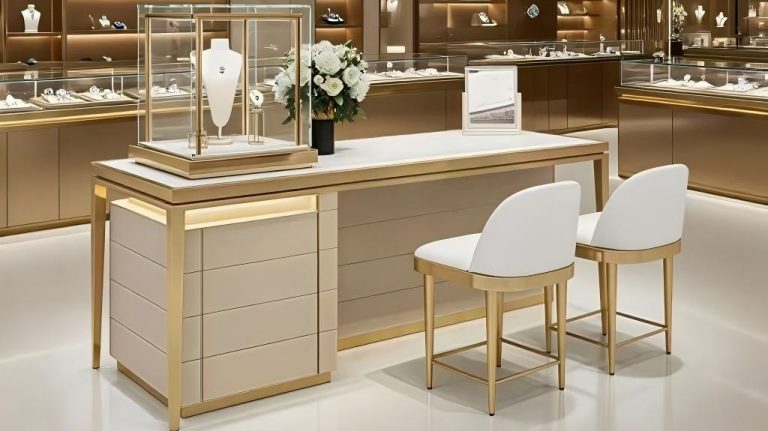
MDF with Veneer or Lacquer
MDF is the industry standard for jewelry display cases. It’s stable, affordable, and takes any finish — from wood veneers that look like solid wood to high-gloss lacquer in any color you want.
Pros: Affordable, stable, won’t warp, unlimited finish options
Best for: Most jewelry stores, especially on a budget
MDF vs Plywood: which one should you choose? →
Solid Wood
Solid wood (oak, walnut, ash) adds warmth and perceived value at a 50–100% premium over MDF with veneer. It’s most often used for accent pieces or high-end boutique concepts.
Pros: Premium feel, unique grain, ages well
Best for: High-end boutiques, accent pieces, wood-focused brand concepts
Stainless Steel / Metal
Metal frames and bases give a contemporary, high-end look. Brushed gold, champagne gold, rose gold, gunmetal, and black are all popular. Stainless steel is durable and easy to clean.
Pros: Sleek modern look, durable, easy to maintain
Best for: Contemporary stores, watch boutiques, minimalist concepts
Stone Tops
Marble, quartz, or stone countertops add luxury and work well for service counters or feature pieces. They’re heavy and expensive, so most stores use them sparingly.
Pros: Luxury feel, unique patterns, durable surface
Best for: Service counters, feature pieces, high-end boutiques
—
Step 3: Get the Lighting Right
Lighting is the most underrated factor in display case buying. Put the same piece in a case with bad lighting and a case with good lighting, and you’ll see a real difference in how customers respond. If you are showcasing necklaces or pendants, a backlit counter can dramatically improve visibility — see our JW-23 backlit counter project for a real example.
Color Temperature
- **3000K warm white** — the standard for most jewelry. Enhances gold, flatters warm stones, creates a cozy premium feel.
- **4000K neutral white** — works for silver, white gold, and very modern concepts. Can make warm metals look flat.
CRI (Color Rendering Index)
CRI measures how accurately light renders colors compared to natural light. For jewelry, aim for CRI ≥ 90. Below 80, stones look dull and settings look cheap.
The Illuminating Engineering Society (IES) publishes the TM-30 standard, which goes beyond CRI to measure both fidelity (accuracy) and gamut (vividness). For jewelry, you want good fidelity plus a slight gamut boost — stones look like themselves, just a touch more alive.
Lighting Types
- **Spotlights** — focused beams that highlight individual pieces and create sparkle. Essential for diamonds and faceted stones.
- **LED strips** — even ambient light around shelves or at the base. Fills shadows and adds depth.
- **Backlighting** — from behind or below. Dramatic, but not right for every piece.
Jewelry display case lighting: a complete guide →
—
Step 4: Pick the Right Glass
For jewelry display, not all glass is the same.
Tempered Safety Glass
Tempered glass is 4–5 times stronger than regular glass. If it breaks, it shatters into small, relatively safe cubes rather than sharp shards. It’s required under the U.S. federal safety-glazing standard 16 CFR 1201 for commercial fixtures.
Any reputable factory will use tempered glass as standard. If a supplier offers “regular glass” to save money, walk away.
Low-Iron (Extra-Clear) Glass
Standard glass has a slight green tint that’s especially visible on the edges. Low-iron glass removes most of that tint for a clearer, more color-accurate view. It costs more — usually 20–40% extra for the glass itself — but for high-end stores or color-sensitive merchandise, it’s worth it.
Glass Thickness
Most jewelry display cases use 6–8mm tempered glass for tops and 5–6mm for sides. Thicker glass is stronger but heavier and more expensive. For counter-top cases, 6–8mm is standard.
—
Step 5: Security and Locks
For jewelry stores, security isn’t optional. Here’s what to look for.
Locks
Not all locks are equal. For high-value merchandise, look for:
- Keyed locks on every case and drawer
- Reinforced lock plates (so they can’t be pried easily)
- Sliding glass doors with security stops
- Concealed hinges where possible
Layered Security
Good security isn’t just about locks. It’s about layers — tempered glass, good locks, alarm systems, and store layout that puts high-value pieces where staff can always see them.
The Jewelers’ Security Alliance — the trade’s crime-prevention body since 1883 — builds its guidance around this layered-security approach.
—
Step 6: Custom vs. Standard
Standard (Catalog) Cases
- **Pros**: Lower cost for small quantities, faster delivery, predictable pricing
- **Cons**: Limited sizes and finishes, may not fit your space exactly, less customization
- **Best for**: Pop-ups, temporary setups, very small stores on a tight budget
Custom Cases
- **Pros**: Exact fit for your space, full control over materials and finishes, cohesive brand look
- **Cons**: Longer lead time (30–45 days), requires planning, minimum order quantities may apply
- **Best for**: Permanent store setups, multi-case orders, stores with specific layout or brand requirements
For most jewelry stores, custom is worth it — the cases are a core part of your store’s look and function, and you’ll live with them for years.
How much does a custom jewelry display case cost? →
—
Step 7: Choose a Manufacturer
Here’s how to evaluate a display case manufacturer.
What to Look For
1. Jewelry experience — Restaurant and clothing store fixtures are different. Look for a manufacturer that regularly does jewelry retail projects.
2. Factory direct — No middleman markup, direct communication with production, easier customization.
3. Sample availability — A factory that won’t send a sample or material swatches is a factory you probably don’t want to work with.
4. Warranty — 1–2 years is standard. Watch for factories that offer no warranty at all.
5. Shipping options — KD (flat-packed) vs. fully assembled, air vs. ocean freight.
Questions to Ask
- Can I see photos of your past jewelry store projects?
- What’s your standard production time and rush option?
- Do you offer 3D design renders?
- What warranty do you provide?
- What glass do you use? (The answer should include “tempered” and a safety standard reference.)
- Can you ship KD or fully assembled?
—
Step 8: The Process Timeline
Here’s roughly what to expect when ordering custom display cases:
| Stage | Time | What happens |
|---|---|---|
| Design & Quote | 3–7 days | Send layout → get 3D design + quote → revisions |
| Sample (optional) | 7–14 days | Prototype case for approval |
| Production | 30–45 days | Cutting → framing → finishing → assembly → QC |
| Shipping | 5 days – 4 weeks | Air: 5–7 days / Ocean: 3–4 weeks |
| Installation | 1–7 days | Depends on project size |
Total: roughly 5–8 weeks from order to install for ocean freight, or 3–5 weeks for air freight.
—
Frequently Asked Questions
What’s the average cost of a custom jewelry display case?
A standard counter runs $300–$800 factory direct. A custom counter with premium materials and lighting runs $800–$2,500. Full-store programs start around $10,000 and go up from there.
How long do custom display cases last?
With normal retail use, a well-built display case should last 10–15 years or more. The parts that wear out first are usually the lighting (LED drivers have a 50,000+ hour lifespan, which is years in retail hours) and the lock mechanisms.
Can I install the cases myself?
Simple counter cases and pedestals arrive ready to use — just place them and plug them in. Wall systems and perimeter cases usually need professional assembly and wiring. Most factories can coordinate installation, or you can use a local contractor.
What’s the difference between KD and fully assembled shipping?
KD (knock-down) means the case ships flat-packed and is assembled on site. It cuts freight by about 50% and reduces damage in transit. Fully assembled shipping is more expensive and carries higher damage risk, but you can use the cases right out of the box.
Do display cases come with lighting?
Most custom cases include LED lighting as standard, but the quality varies. Always ask about CRI (aim for ≥90), color temperature, and whether the LEDs are replaceable.
Can I match existing cases in my store?
Yes. A good factory can match existing finishes, materials, and proportions — just send photos and measurements.
—
Ready to Start Your Project?
If you have a store layout, sketch, or even just a list of what you need, send it over for a free 3D design and detailed quote. No obligation, no pressure.
Every case is built to your exact specifications, direct from the factory. Production runs 30–45 days, and we ship worldwide.