Получить бесплатный расчёт
-
Тел./WhatsApp +86-13925899945
-
Эл. почта: [email protected]







Коробки для витрин косметики: 12 идей компоновки для средств по уходу за кожей, макияжа и парфюмерии
12 cosmetic display boxes ideas for beauty stores: backlit niches, tester trays, fragrance tables and kiosks, with shelf heights, lighting and material specs.
Содержание
- Основные выводы
- Why do cosmetic display boxes fail before production?
- Which layouts work on a wall run?
- Which island layouts hold the most stock?
- How do you build a tester station that survives?
- What changes between fragrance, skincare and makeup?
- How high should shelves be, and how wide should the aisle be?
- What lighting and materials should you specify?
- What does the factory need from you?
- Часто задаваемые вопросы (ЧАВО)
- Get a layout and quote
Основные выводы
- McKinsey projects the global beauty market growing 5% a year through 2030 to $590 billion. E-commerce already takes 28% of beauty sales, so the store has to sell the try-on, not the shelf.
- The twelve layouts below cover the four jobs a beauty floor does: wall display, island stock, tester handling and fragrance.
- Sellable stock belongs between 15 and 48 inches above the floor, and accessible routes need 36 inches of clear width.
- Acrylic clouds and crazes under perfume and alcohol. Use tempered glass or PETG wherever an open tester sits.
- Specify CRI 90+ light: 3000–3500K for fragrance, 4000K for skincare and makeup.
Why do cosmetic display boxes fail before production?
Most “cosmetic display boxes” results online are renders of white boxes with products floating inside. In this guide the term covers the shop-fitted units that hold beauty stock, not retail packaging: wall bays, counters, islands and kiosks. The renders answer nothing a shopfitter needs on day one: how many facings, where the tester sits, and what happens when a customer opens a serum bottle over an acrylic tray.
Four gaps cause most of the rework:
- SKU count is unknown. A wall drawn for 60 SKUs fails at 110. Fix the facing count before the shelf pitch.
- Testers are decoration. They get the same shallow shelf as stock, no spill zone, no wipe-down access.
- Power is an afterthought. LED runs, lit niche backs and mirror lights exceed a standard retail circuit, and the mall prices the upgrade.
- Cleaning is not designed in. Removable trays, sealed joints and a vacuum gap behind the toe kick decide whether closing takes ten minutes or forty.
The commercial case for getting this right is in the channel data. McKinsey’s 2026 beauty analysis puts e-commerce at 28% of global beauty sales, grocery at 19% and specialty beauty retail at 18%. The same survey found just over half of consumers describe beauty as “feeling confident,” ahead of “looking attractive to others.” That is a fixture brief: the customer needs to touch the product, see it on skin, and be lit properly while doing it.
Which layouts work on a wall run?
The wall carries the brand story and most of the accessible stock. Three layouts cover different budgets.
1. Backlit arched niches, one story per bay
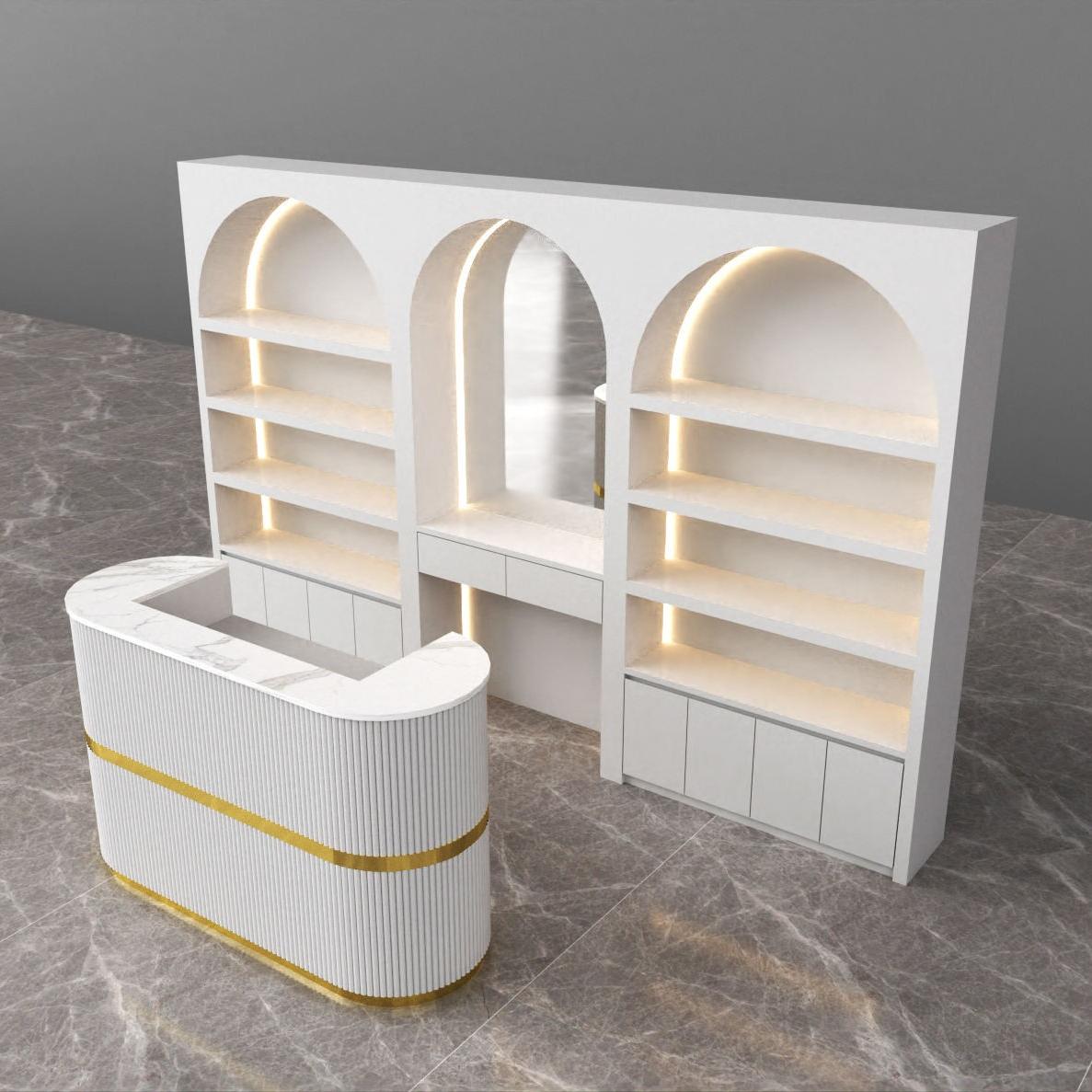
The arched niche wall in this cosmetic display counter programme is the most reusable idea here. Each arch frames a brand or category, the back panel glows, and the shelf line stays hidden. Because a niche is a box, it also controls light spill: the product reads bright while the wall stays calm.
Details that matter: keep the niche 300–350 mm deep so a 50 ml bottle and a price tag both fit, run the LED behind a diffuser rather than in the sightline, and put a 40 mm dust lip at the bottom. Without the lip, every shelf change leaves powder on the shelf below.
2. Gold-framed shelving with stone backs
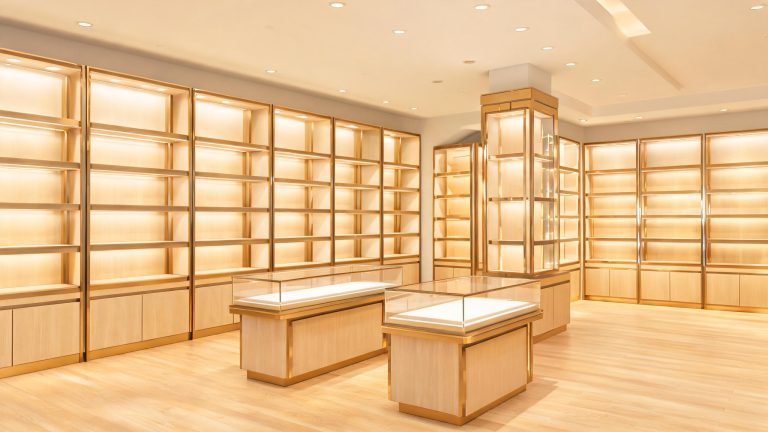
A gold frame shelf wall trades the lit niche for open shelving and a marble-effect back. It costs less per square metre and photographs well, but it demands discipline: brackets adjustable on a 32 mm pitch, and a levelling foot so the frame does not drift once the floor settles.
3. Slatwall inside a framed bay
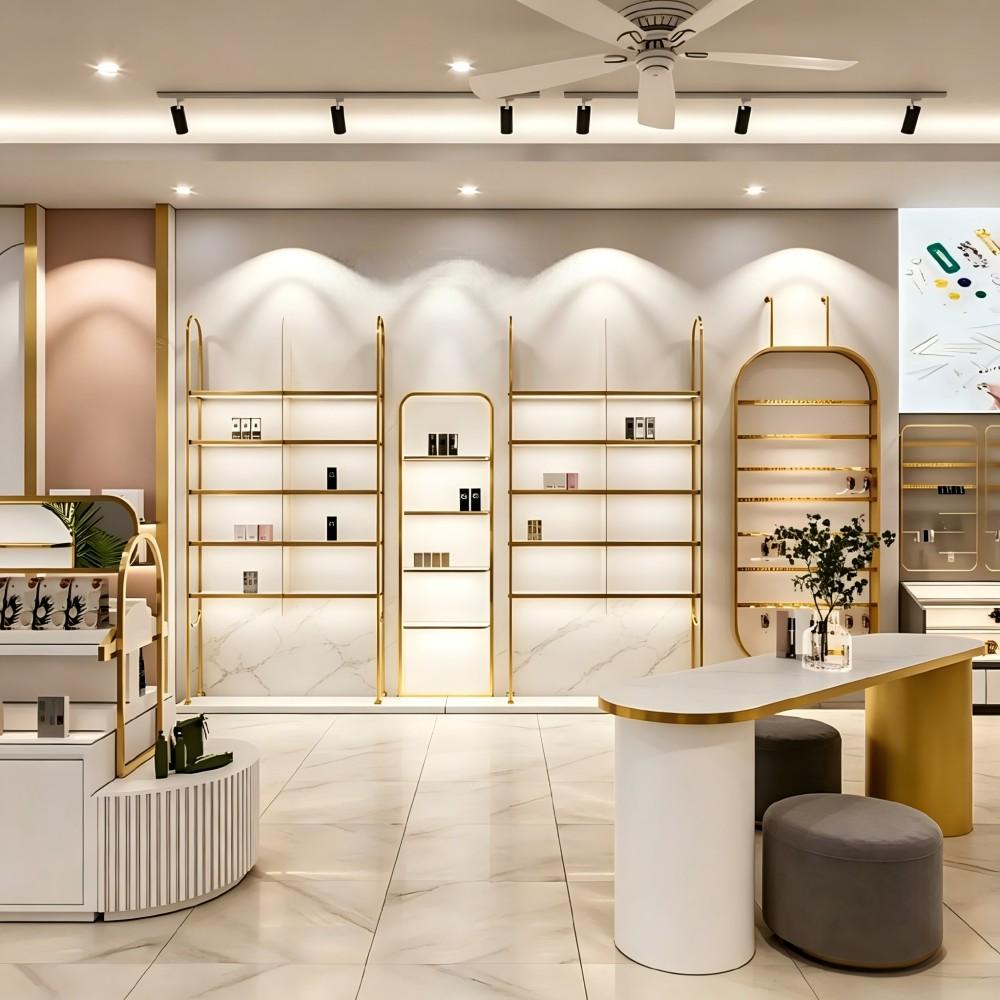
Проект arched wall with exposed slatwall in a U.S. store solves the flexibility problem. Two uprights and a head rail hold two slatwall fields, hooks move in minutes, and the centre bay stays open for a lightbox.
The failure mode is depth: hooks project 60–80 mm, so the bay must be deeper than hook plus product. On a 300 mm shelf, a mask jar on a hook hangs over the aisle.
Which island layouts hold the most stock?
Islands earn their floor area by holding volume and letting customers circle. Four shapes do most of the work.
4. Glass-top counter with a drawer bank
A glass deck over a closed carcass is still the best mix of display and stock. In the New Zealand counter, the glass carries the hero range while lockable drawers hold boxed stock. Our rule: one drawer per 1.2 m of counter, on the staff side only, so customers never open stock by accident.
5. Tiered perfume table with globe lighting
Проект perfume table display uses three steps plus globe pendants. Fragrance needs height variation, because 100 ml bottles look identical from above. Steps at roughly 120, 240 and 360 mm let the back row read over the front row without hiding labels.
Keep the tallest step for refills and gift sets. A 360 mm riser on a 900 mm table puts a bottle at 1,260 mm, fine for most adults but outside ADA reach once the table depth is counted.
6. Double-sided gondola with mesh backs
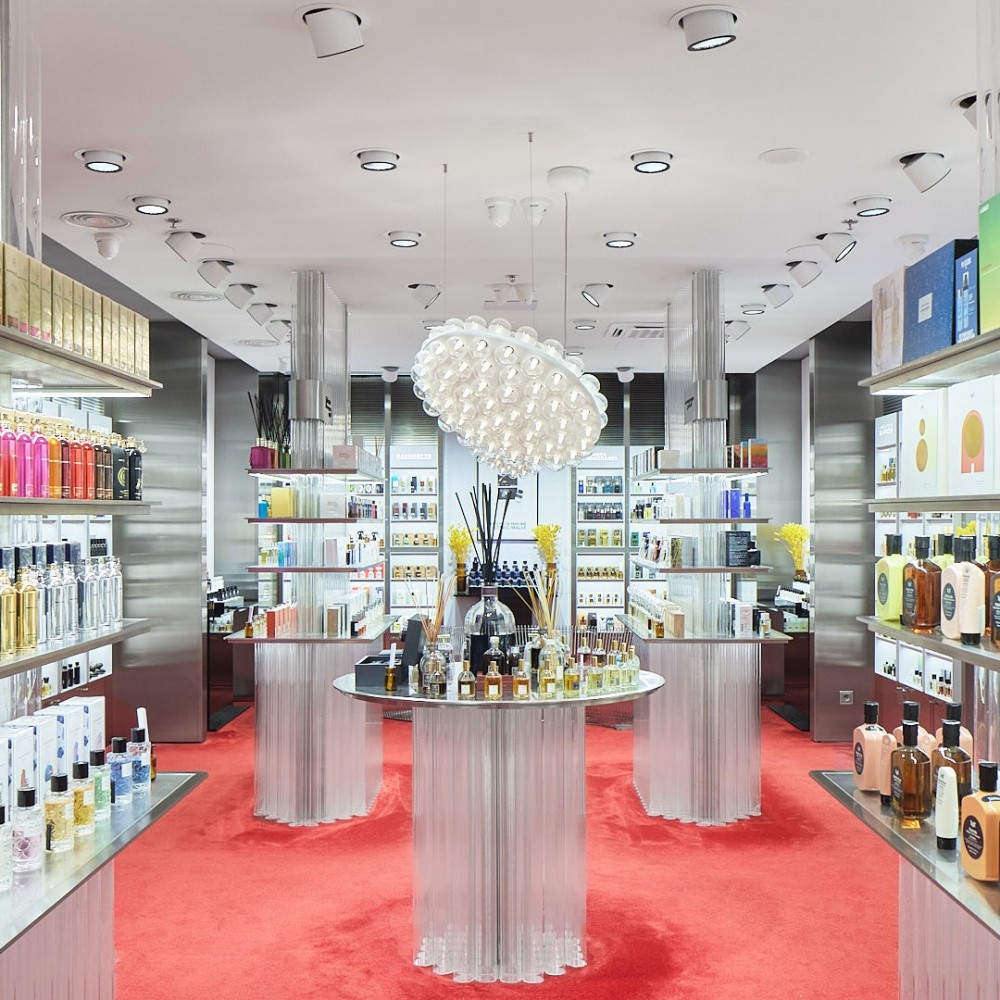
A double-sided cosmetic island gives two selling faces from one footprint. Perforated mesh backs keep the unit light, let LED strips pass, and stop small stores reading like stockrooms.
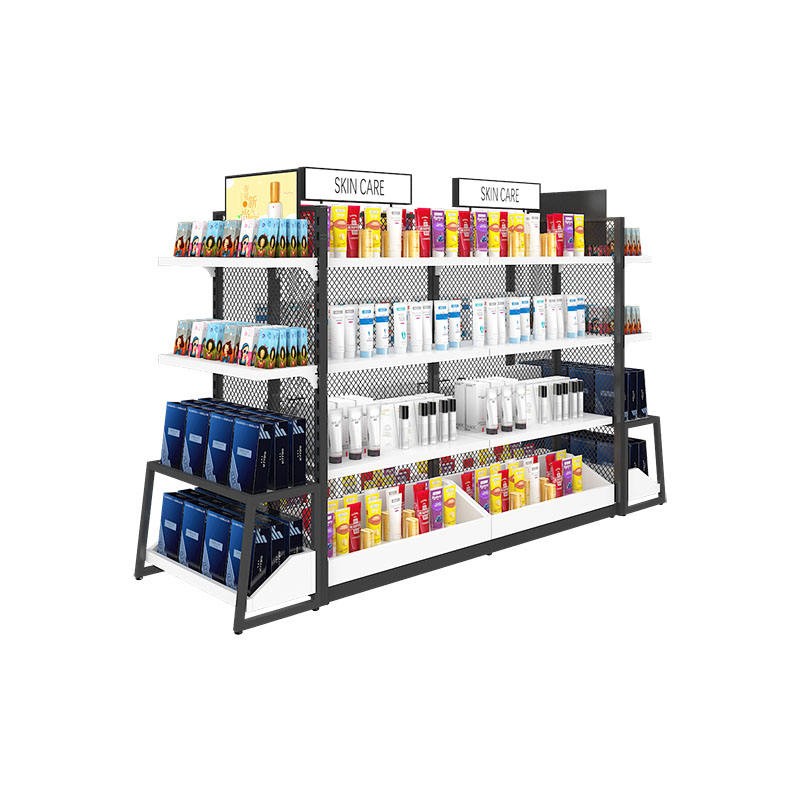
7. A-frame endcap with stepped shelves
For narrow aisles, an A-frame cosmetic display rack adds facings without widening the walkway. Three shelves at about 15 degrees are enough to read a label without the bottle sliding forward.
How do you build a tester station that survives?
Testers are the most abused surface in a beauty store. Design for that, not for opening day.
8. Sloped tester tray inside a glass counter
A removable tray at 10–15 degrees keeps bottles facing the customer and contains drips. Two details matter more than the angle. Material: acrylic crazes and clouds under fragrance, so use tempered glass or PETG at any surface where an open bottle sits. Removal: the tray needs a finger gap so staff can lift and wash it. A tray that must be unscrewed will not be cleaned.
9. Mirror and light station
A mirror with vertical LED at 4000K turns a display into a try-on point. Put it at the end of the run, not the middle: it pulls customers through the store instead of parking them at the entrance.
What changes between fragrance, skincare and makeup?
10. Fragrance tower with warm light
Fragrance has overtaken colour cosmetics as the third-largest beauty category and is the most consistent grower across price tiers in McKinsey’s forecast. The fixture brief changes accordingly: more height, warmer light, sealed shelves.
Fragrance oil attacks paint edges and unsealed MDF. Specify a sealed shelf surface, a glass or stainless spill zone at the tester, and 3000–3500K light with high R9 so ambers do not turn brown.
11. Shallow colour-coded drawer wall for makeup
Colour cosmetics needs density and speed. A wall of shallow drawers, coded by category, lets staff restock in one pass and lets customers find a shade without opening every unit. Depth matters: 75 mm holds lipsticks and compacts, deeper drawers waste cube and invite mixed stock.
12. Mall kiosk with a suspended canopy
A mall makeup kiosk applies the same logic in an island. With no back wall, the kiosk carries its own lighting and stock: a киоск косметики typically uses a suspended canopy for the light line and closed cabinets below the deck.
How high should shelves be, and how wide should the aisle be?
These are not matters of taste. The стандартами ADA 2010 года cap high forward reach at 48 inches, start low reach at 15 inches, and require 36 inches of clear route width. Beauty floors usually run wider, at 1,200–1,500 mm, because two customers at a tester already block a 36-inch path.
| Zone | Height above floor | What goes there |
|---|---|---|
| Low stock | 15–24 in | Large formats, gift sets, refills |
| Prime selling | 30–48 in | Hero SKUs, testers, best sellers |
| Secondary | 48–60 in | Backstock facings, category signage |
| Staff only | 60 in and above | Display stock, seasonal, decor |
Above 60 inches is out of reach for many customers; below 15 inches is a cleaning problem. Both zones should hold stock staff can retrieve, not products you expect customers to pick up.
What lighting and materials should you specify?
Освещение. Ask for CRI 90+ with a strong R9 value. Lower grades turn red lipstick brown and skin tones grey. Use 4000K in skincare and makeup where shades are compared, 3000–3500K in fragrance where warmth supports the product. Keep strips behind diffusers and heat away from wax, cream and alcohol.
Materials, ranked by abuse tolerance:
- Tempered glass for counters, tester decks and spill zones. It scratches less than acrylic and cleans with alcohol.
- PETG where you need a clear tray that will not shatter. It resists alcohol far better than acrylic.
- Powder-coated steel for frames and legs. Chipping exposes bare metal, so ship a touch-up pen with every delivery.
- HPL or melamine-faced board for backs and shelves where cost matters. Seal every cut edge; raw MDF swells the first time a tester leaks. PU paint looks better than laminate and marks more easily, so keep it to feature walls.
What does the factory need from you?
A factory can quote a cosmetic display box programme in a day if four documents arrive together:
- A dimensioned floor plan with wall runs, island positions and aisle widths marked.
- A SKU list with bottle heights and widths, split into stock and tester.
- Brand assets: logo files, colour references, mandated materials.
- The mall or landlord criteria sheet, including power allocation and fire-rated material requirements.
After that the sequence is standard: drawings signed off, a sample in 7–10 days, production in 30–45 days, then KD flat-pack or assembled shipping from Guangzhou. If you are still choosing fixture types, start with 7 типов витрин; the идеи для витрин ювелирных изделий collection applies the same wall, island and tester logic to a neighbouring category.
Часто задаваемые вопросы (ЧАВО)
How much do cosmetic display boxes cost?
A single glass-top counter sits in the low four figures FOB South China. A full illuminated wall plus islands is a project, not a unit price, and the total moves with lighting density, glass area and finish. A number quoted before the floor plan is a guess.
Do I need a tester for every SKU?
No. Test one shade per colour family and one size per fragrance family. Testers consume stock and space; the goal is coverage of the decision, not of the catalogue.
Can I use acrylic trays for perfume testers?
Not for long. Perfume and alcohol cloud acrylic and craze it at the bend. Use tempered glass or PETG wherever an open bottle sits.
What lead time should I plan for?
Seven to ten days for a sample, thirty to forty-five days for production, then freight and installation. Mall approval runs in parallel and is the item most often forgotten.
Get a layout and quote
Send a floor plan and your SKU list. We will return a marked-up cosmetic display boxes layout with fixture types, shelf heights and a lighting plan, plus a factory quote. If the plan is not final, a free 3D design settles the wall and island mix before production.